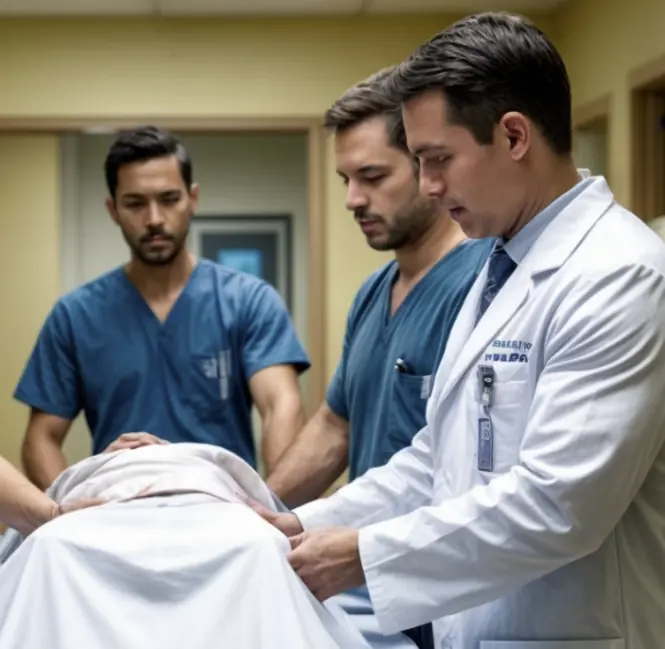
Dr. Marcus Hale never wasted words. He was a man of brisk decisions and clipped orders—exactly the sort the emergency room needed when the night swelled with sirens and bodies. The staff respected his competence; some admired his certainty. They did not always admire the way he said things.
That night was one of those when certainty curdled into something else. The ER had been slammed with a multi-car pileup. Rooms were full, monitors beeped in a hectic chorus, and the waiting area smelled of antiseptic and fear. Among the fresh arrivals was an elderly woman—thin, with hair the color of moth wings and a face like paper that had been folded too often. She had been brought in by ambulance after a neighbor found her collapsed on her kitchen floor.
“Ninety-two,” the EMT said. “Lives alone. No DNR on file, but she’s frail—looked like she’d been down for a while.”
The woman’s eyes opened once as they transferred her. They were cloudy but alive; they found mine and settled there for a second with that raw human questioning—where am I? who are you?—before falling away.
Dr. Hale glanced at her chart, then at the stretch of occupied beds. “Trauma bays are full,” he barked. “We triage. If she’s stable, corridor bed. We need capacity for the criticals.”
“She’s breathing shallow,” the nurse said. “BP low, but we can monitor.”
“If she’s not one of our ten highest priorities, we can’t afford the space,” Dr. Hale returned. He looked tired. So did everyone. “Tell orderlies to move her to the corridor bed by Bay C. She’s probably not going to make it anyway—save our resources for those with better odds.”
The words landed like a hammer. No one disputed the clinical decision; no one liked the way he’d said “not going to make it anyway” as if it were a measurement, not a life.
Tom, the orderly assigned, was younger than the chart suggested. He’d worked nights for two years and had learned to make room for the humanity behind the paperwork. He wheeled the gurney slowly down the hallway, past doors where families clustered, past the fluorescent glare that made people look thinner. He placed the woman where instructed—on the plastic-covered bench under a harsh light in the corridor between two curtained bays. The blanket he tucked round her knees was thin.
Tom lingered for a moment—an impulse of kindness—lowing the lamp, adjusting the blanket so her chin didn’t wobble. He noticed a badge clipped to her cardigan: “MARIA BENNETT — VOLUNTEER” in faded letters. He read the curling script of a phone number on a Post-it tucked into the chart and committed it to memory.
He had a small habit he’d picked up from his grandmother: he petted dogs. When he left, he paused by the therapy-dog cart to check the roster. Biscuit, a rescued lab mix with a penchant for biscuits, was due to make his rounds. Biscuit belonged to the hospital volunteer program—brown eyes like soft wood, a tail that swept like an optimistic broom. Tom nudged the volunteer’s clipboard and said, “Make sure Biscuit visits the corridor beds too. They don’t all have family.”
The volunteer smiled but seemed under orders from the administrative side to circulate in the main lobby only. “Red tape,” she sighed. “But I’ll do my best.”
Biscuit, however, had other ideas. Dogs have a GPS tuned for grief, for the scent of loneliness. Half an hour later, as monitors screamed and nurses walked past in a blur, Biscuit wrenched his leash free in the lobby and trotted down the hallway like he’d been called by something that mattered more than schedules.
He found Maria in the corridor and did what dogs do without planning: he dropped to his belly and pressed his warm head on her hand. Maria stirred, and for the first time that night a slow smile crossed her lips, less an expression than a returning tide.
Someone caught the brief exchange on a passing nurse’s phone—nothing staged: a dog and an old woman, two beings recognizing one another. The clip was a soft thing that swam gently out of the clinical tumult.
An hour later, Tom returned to check on his corridor assignment and found Biscuit still there, curled beside Maria as though his breath fended off the cold. Maria’s pulse was steadier. Her oxygen saturation had dipped but was climbing back when the nurse noticed. Someone fetched a spare nasal cannula from a supply closet and gently placed it beneath her nose. Her breathing eased like a knot unwinding.
By morning, the ER had stabilized the immediate casualties enough to arrange beds. Maria’s chart moved, slowly, from ‘expectant’ to ‘monitor closely’. The change was subtle—a few adjustments, a measured dose of oxygen, a warm blanket, the consistent weight of a dog who refused to leave.
Dr. Hale floated through the ward early the next day to check on a trauma patient, and the scene stopped him. A small crowd had gathered—a cluster of staff leaning against a counter, the volunteer coordinator holding her tablet, a couple of residents whispering. And in the middle of it, under the fluorescent flares, was Maria awake enough to smile, Biscuit’s head on her lap like a guardian. Her family—her granddaughter, out of breath from driving across town—had arrived. Tears and laughter braided together as they tried to speak all at once.
Someone had uploaded the clip of Biscuit that Tom mentioned to the hospital’s intranet and then to a local social feed. It had spread fast: “Old woman saved from despair by therapy dog,” read the headline. Local reporters called. A nurse posted a thread about compassion in corridors; donations for the volunteer program poured in.
Dr. Hale’s face, when the hospital director forwarded him the morning email, was a portrait of something like outrage—not the righteous kind, but the sharp, embarrassed heat of a man surprised to be wrong and on the evening news for it. He had been right about triage care—he believed that—but he had not anticipated the human cost of curt words. He had not expected an old volunteer’s life to become the fulcrum of the hospital’s reputation.
He stormed into the staff lounge, where Tom was finishing a coffee. “Why wasn’t she in a bay? Who thought leaving her in the corridor with just a blanket was acceptable?” His voice carved the air.
Tom, steady as always, met his gaze. “She was triaged. Beds were full. We didn’t ignore her. We monitored. She was awake later because Biscuit would not leave. He got the nurse’s attention. If you want someone to blame for her being stable now, blame a good dog and a volunteer who didn’t stick to the schedule.”
Dr. Hale’s jaw clicked. The outrage in him was complicated. It was indignation at the lack of control, at the hospital’s being made vulnerable by a tiny, viral story. He wanted a report, an explanation, a scapegoat. He wanted to close the file on a night that now had meaning beyond scalpel vs. suture.
But as the hours passed and the headlines rolled, something else happened. Staff who had felt the sting of his tone reached out one by one to recount the small kindnesses that had saved the night—an orderly who folded a blanket, a nurse who spent five minutes coaxing oxygen into a tired body, a volunteer who realized that protocols were meant to serve people, not the other way around. The hospital director, faced with the public’s reaction and the team’s quiet courage, called a meeting where Dr. Hale, for the first time in a long while, listened instead of judged.
When he finally visited Maria, she was sitting up in bed, her granddaughter holding her hand. Biscuit dozed at her feet, a travel-worn ribbon around his collar where someone had tied a small bow. Maria’s eyes found the doctor’s and, with the clarity of someone who’d seen more winters than he had, she said, “You were busy, weren’t you, doctor?”
He opened his mouth and closed it. There was no defense that mattered.
“Thank your dog,” she said softly, nodding at Biscuit.
Dr. Hale crouched to pet the lab, feeling the slow, trustworthy energy under his palm. The dog’s eyes lifted, and something in the doctor’s posture softened like thawing frost.
That evening, in the staff room, Dr. Hale apologized—not in a statement, not for the cameras, but to the orderly who’d insisted on small kindnesses, to the volunteer who’d bent the rules for a corridor, to the nurse who’d fetched the oxygen. His words were not theatrical; they were private, small, and meant to be heard. They were, by any humane standard, overdue.
The local news ran a follow-up: “Elderly Volunteer on the Mend After Therapy Dog Aids Recovery; Hospital Staff Praised for Compassion.” Dr. Hale watched it, discomfort and, in the same glance, a dawning gratitude cross his face. He had been outraged—for a moment—by what had happened, because it had shown him an anatomy of care he’d overlooked. That outrage cracked open into something better.
Months later, Maria walked the hospital corridor again, steady with a cane and flanked by her granddaughter. Biscuit trotted beside her, tail sweeping the linoleum as if it knew the route by heart. People stopped to pat the lab and to exchange stories about the night when a dog’s insistence bent the architecture of an ER long enough to let mercy through.
Dr. Hale would still be Dr. Hale—decisive, sharp, necessary. But he kept a different thing in his pocket now: a folded Post-it with an emergency contact number and the tiny reminder Tom had given him that night—“People first. Protocols second.” He never admitted to anyone that he carried it; he just did. And sometimes, late at night, when the ER hummed and the monitors blinked like distant stars, he paused by the corridor where Biscuit liked to nap and let the dog say, in the language of soft eyes and warm head, what the charts could never show: that triage isn’t just about saving bodies, but about saving the dignity that makes them human.