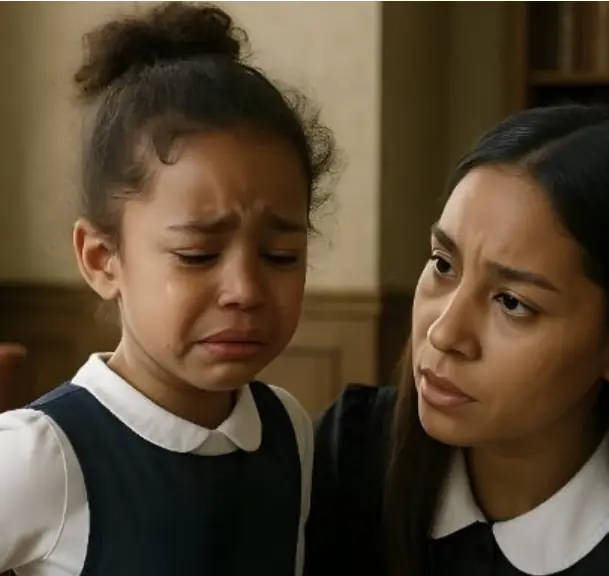
The Hawthorne Estate stood on the edge of the city like something carved out of another century — marble columns, endless gardens, and windows that glowed with quiet privilege. Every corner whispered wealth. Every shadow hid something else.
To Amelia Reyes, it wasn’t a palace. It was her workplace.
She’d been a maid there for seven years — unseen, unheard, invisible by design. Her uniform was crisp, her silence rehearsed. The staff joked that the mansion could run itself because no one dared breathe too loud in front of Mrs. Evelyn Hawthorne, the mistress of the house.
Amelia followed the rules. Until the day she didn’t.
It began one cold morning in February. She was polishing the silver in the dining hall when she heard it — a sound she couldn’t mistake. A muffled sob.
It came from upstairs, the east wing, where Mrs. Hawthorne’s stepson, Liam, had lived since his father’s death. The boy was twelve now, quiet, polite, with a habit of shrinking from touch.
Amelia hesitated — staff weren’t supposed to go up there without permission — but something in that sound pulled her.
She climbed the steps slowly, each creak of the wood echoing her heartbeat. At the end of the hall, she found the door slightly open. Inside, Liam sat on the floor beside his desk, clutching a torn drawing — a family portrait, ripped straight down the middle.
When he saw her, he flinched.
“Sorry, Miss,” he said quickly, wiping his face. “I’ll clean it.”
Amelia knelt beside him. “You don’t have to.”
He didn’t respond. He just stared at the carpet, jaw trembling.
“Did someone hurt you?” she asked softly.
He shook his head too fast. “I fell.”
It wasn’t convincing.
That night, Amelia couldn’t sleep. The sound of that sob lingered in her ears. She knew better than to interfere — servants who asked questions didn’t stay long in places like Hawthorne Estate. But she’d grown up around silence like that. She knew the difference between fear and clumsiness.
The next morning, she brought Liam breakfast herself. When she entered his room, she noticed new bruises along his arm — faint, but there.
He caught her staring. “Please don’t tell her.”
Her heart sank. “Who?”
“Mrs. Hawthorne,” he whispered. “She says I make her angry. That I look too much like him.”
Him. His father. The late Mr. Hawthorne — the man whose portrait still hung in the main hall, eyes forever watching.
Amelia’s chest tightened. She’d suspected cruelty in this house — she’d seen the broken glasses, the slammed doors, the way Evelyn’s smile turned sharp when guests weren’t looking. But to know it reached the boy…
She wanted to act. But how?
The following week, an accident happened. Or that’s what Mrs. Hawthorne called it.
A vase shattered in the study — a priceless antique. Liam was blamed. He was locked in his room for “reflection.”
Amelia couldn’t take it anymore. That night, she took a tray of food and slipped upstairs. The door was locked from the outside.
She whispered through the keyhole, “Liam?”
A small voice answered. “I’m okay.”
“You shouldn’t be in there,” she said. “I’ll find a way.”
“Don’t,” he pleaded. “She’ll fire you.”
Amelia swallowed hard. “It’s not about me.”
The next morning, Amelia requested a day off. She went into the city and found a payphone near the library. Her hands shook as she dialed.
“Child Welfare Services,” said a voice.
She hesitated. Her heart raced. “There’s a boy,” she began. “At the Hawthorne Estate. I think he’s in danger.”
“Your name, ma’am?”
She almost hung up. But then she remembered the bruises, the fear in his voice.
“Amelia Reyes,” she said. “Please, hurry.”
Two days later, the inspectors came — unannounced, dressed in plain suits. The household buzzed with tension. Evelyn’s perfect smile barely masked her fury.
“Someone made an anonymous complaint,” she said through gritted teeth. “How insulting.”
She turned her gaze to the staff lined up by the kitchen. “I hope none of you had the audacity.”
No one moved. Amelia kept her head down, polishing silver again, heart hammering.
The officers left hours later after interviewing everyone, including Liam. They found nothing “conclusive.” Evelyn had rehearsed her charm too well.
That night, she dismissed half the staff.
Amelia was among them.
She packed her few belongings quietly. As she was leaving, Liam ran into the hallway, out of breath.
“They’re making you go?”
She nodded, forcing a smile. “It’s all right.”
He bit his lip, eyes wet. “Thank you,” he whispered. “For trying.”
She crouched down, cupping his cheek gently. “Promise me something, Liam. When the time comes, tell the truth. Don’t be afraid.”
He nodded. She hugged him — just once — and left.
Months passed. Amelia found work at a bakery in town. The pay was little, but peace was priceless.
She tried to forget, but couldn’t. She read the newspaper every morning, hoping for a headline, a name, something. Nothing came.
Then, one evening, a familiar voice called her name.
“Miss Reyes?”
She turned — it was Detective Rowan, one of the officers who’d visited the mansion.
“We’ve reopened the case,” he said. “New evidence came in. Letters — from the boy.”
Amelia’s knees nearly gave out. “Is he safe?”
“He is now. He’s been placed with relatives out of state.”
Tears stung her eyes. “Thank God.”
Rowan smiled faintly. “He wrote something for you.”
He handed her a folded piece of paper. Inside, in shaky handwriting, were the words:
You told me not to be afraid. I wasn’t. Thank you for seeing me when no one else did.
Amelia pressed the letter to her chest, sobbing quietly.
A year later, she was working full-time at the bakery when a customer walked in — a well-dressed woman with dark sunglasses and a voice she recognized instantly.
Evelyn Hawthorne.
Amelia froze, flour dusting her hands. Evelyn removed her glasses, her face thinner now, elegant still but cracked around the eyes.
“You,” she said coldly. “You ruined me.”
Amelia didn’t flinch. “No, Mrs. Hawthorne. You did that yourself.”
Evelyn’s jaw tightened. “You think anyone will believe you? The boy was ungrateful. He—”
Amelia cut her off quietly. “He doesn’t have to prove anything anymore. He’s free.”
Evelyn glared for a moment, then turned sharply and left.
As the door closed, the bell chimed softly — a small, perfect sound of release.
That night, Amelia walked home beneath the city lights, her apron still dusted with flour. She stopped by a bridge overlooking the river — the same place she used to pause before taking the bus to the mansion.
The wind smelled of rain, and for the first time in years, she allowed herself to breathe deeply.
She reached into her bag and unfolded Liam’s letter again. The paper was worn now, corners soft, words still bright.
At the bottom, she’d added her own in pencil:
Sometimes courage isn’t loud. It’s just doing the right thing once — and never regretting it.
Years later, when the bakery became a community café, people hung photographs of “local heroes” on one wall.
Among firefighters and teachers was a quiet image of Amelia — hair graying, eyes gentle, smile small. Beneath it, a quote read:
“She built nothing grand, but she helped tear down what hid behind grandeur.”
And if you looked closely, taped beside it, was a child’s drawing — a mansion, a sun, and two stick figures holding hands.
In the corner, in crooked handwriting:
For Amelia. My friend. My rescuer.