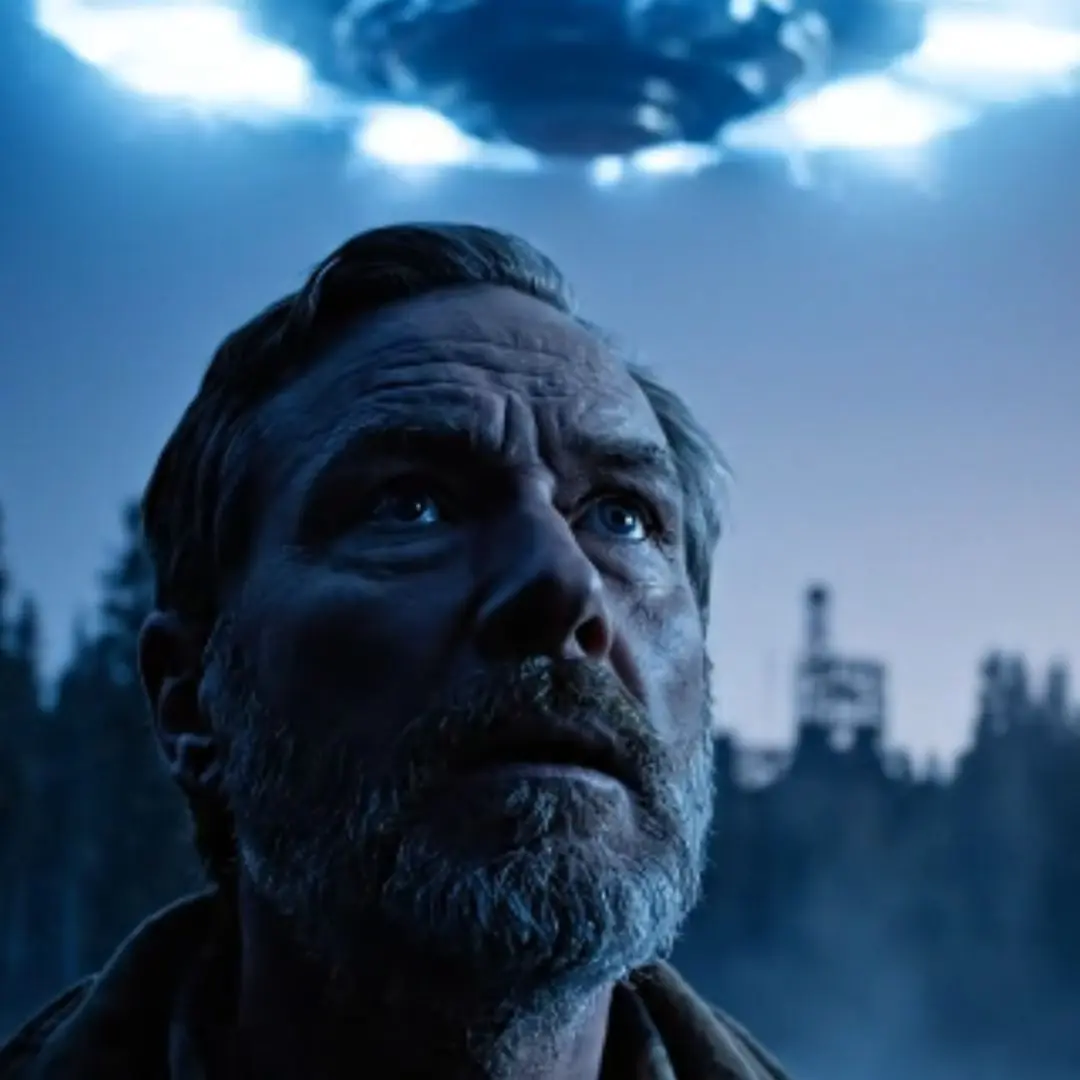
It started on a Tuesday night—the kind of quiet, windless night when Cedar Creek felt smaller than ever. The town had only six hundred people, one grocery store, and a lake that glimmered under the moon like a secret. I was walking home from my shift at the hardware store, thinking about nothing in particular, when I saw the light.
At first, I thought it was a helicopter—just a low, pulsing glow hovering above the lake. But the sound never came. No blades, no hum. Only the frogs and the distant croak of a heron. The light shifted color—from white to blue, to a strange amber that shimmered like heat haze.
I froze by the water’s edge. The air felt electric, buzzing under my skin. The light darted upward, stopped midair, then descended again—smoothly, like a pendulum moving in liquid. I wanted to take out my phone, but my hands wouldn’t move. Then, as quickly as it appeared, it shot straight up into the sky and vanished.
When I told Sheriff Harlen the next morning, he laughed so hard his coffee spilled.
“Lyle,” he said, wiping his chin, “you’ve been reading too many internet stories.”
But I wasn’t joking. “Ask anyone who lives near the lake,” I said. “Somebody must’ve seen it.”
No one had. Or at least, no one admitted to it.
By the end of the week, I was “the UFO guy.” Teenagers honked when they passed me on Main Street. Someone even left a tinfoil hat on my porch. I told myself it didn’t matter, but the truth was—it did. Cedar Creek was the kind of place where gossip spread faster than wildfire. I started avoiding people.
Then, three nights later, I saw it again.
This time I was ready. I stood by the lake with a flashlight and my old Nikon camera. At 11:47 p.m., the same hum returned—a vibration, deep and low, not in my ears but in my chest. The light emerged from the trees across the water, brighter now, like a miniature sun. I snapped a photo, but when I checked the screen, there was only static. The light moved toward me, the air crackling. I stumbled back, tripped on a root—and the next thing I remember, I was lying on the ground. The flashlight was gone. The lake was still. It was 2:10 a.m.
When I woke the next morning, my neck ached, and a small red mark burned behind my ear. The skin was hot, tender. My phone showed no photos. Only blank, black files.
That day, I went to see old Mrs. Carrow, who lived near the lake her whole life. She poured me tea, then said quietly, “You’re not the first, Lyle.”
“What do you mean?”
She nodded toward the woods. “1963. The old power station workers saw lights too. They called it the ‘Cedar Glow.’ Two of them quit and moved away. One never came back from a hunting trip.”
Her words stayed with me. That night, I went into the forest myself. I found the remnants of the old power station—just concrete and rust. And in the dirt nearby, something metallic caught the moonlight. I picked it up: a triangular fragment, smooth and cold, lighter than it should’ve been. I slipped it into my pocket.
The next morning, I woke to the sound of my dog barking madly. A black SUV was parked outside. Two men in suits stepped out—no badges, just calm smiles.
“Mr. Harlan Lyle?” one said.
“Yes.”
“We’re from the Department of Environmental Safety. We’d like to ask about something you may have found near Cedar Creek.”
I lied. Said I didn’t find anything. They thanked me politely and left. But that night, my house phone rang once—just once. When I picked it up, there was only static.
Days passed. My dog refused to go near the woods. My mark behind the ear itched constantly, like something alive beneath the skin. When I finally went to the clinic, the nurse frowned and said, “Looks like a burn. But… metal residue?”
Then came the storm.
Lightning over Cedar Creek lit up the sky like daylight, and for a moment I saw it again—three lights this time, arranged in a perfect triangle, hovering silently. They tilted once, then rose into the clouds. The next morning, the entire town lost power for four hours.
By then, even the Sheriff stopped laughing. People started whispering—“Maybe Lyle wasn’t crazy after all.” Farmers found their cattle with circular burns, fences melted like wax. And one night, Mrs. Carrow’s house caught fire. When I rushed to help, the flames were oddly blue. In her garden, the grass was flattened in a perfect circle.
I never saw the light again after that week. The mark behind my ear faded, but sometimes I still hear the hum when the night is quiet enough. Last winter, I finally decided to move away. But when I packed my things, I realized the triangular fragment was gone.
Maybe someone took it. Maybe it was never really there.
But sometimes, when the fog hangs over the lake, I see a faint shimmer—blue and gold, pulsing beneath the surface like something waiting to rise again. And I know one thing for sure:
Cedar Creek isn’t as quiet as it seems.