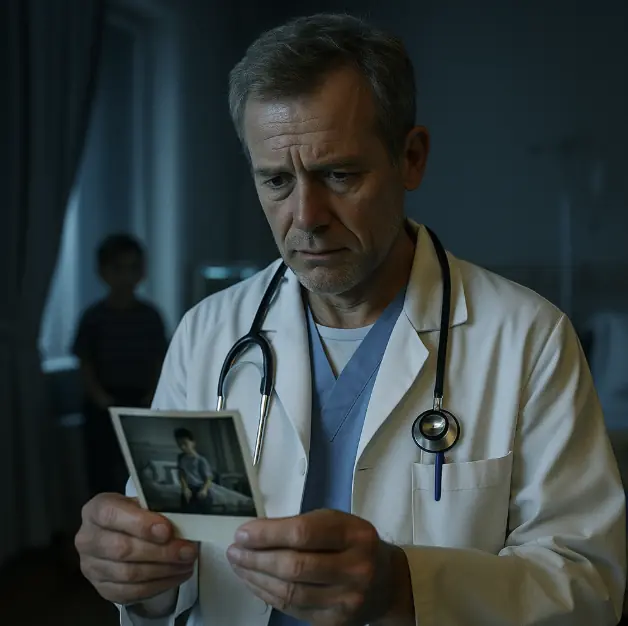
The night shift at St. Mary’s always smelled faintly of antiseptic and rain. The storm outside had been pounding the city since dusk, and every flash of lightning made the fluorescent lights flicker. I was used to nights like this—quiet, tense, unpredictable.
As a trauma doctor, I’d seen it all: broken bones, car wrecks, gunshots, heartbreak. But that night was different. That was the night the hospital itself seemed alive.
I clocked in at 10 p.m. sharp. The ER was unusually calm, only the steady hum of monitors filling the air. At the nurses’ station, Lydia, our head nurse, handed me a clipboard. “Got a new transfer from the psychiatric ward,” she said. “Elderly woman, mid-seventies. No physical injuries, but she keeps asking for ‘Dr. Hayes.’ That’s you.”
I frowned. “She asked for me by name?”
“Specifically,” Lydia said, raising an eyebrow. “You know her?”
I shook my head. “Not that I remember.”
When I entered Room 312, the air felt heavier—colder, somehow. The woman was sitting up in bed, her eyes a pale gray that seemed almost colorless. Her hands trembled slightly as she twisted the edge of her blanket.
“Good evening, Mrs.—” I glanced at her chart. “—Langford.”
She smiled faintly. “You came back.”
I froze. “I’m sorry?”
“You always come back,” she whispered. “Every time.”
Her voice was calm, but something about it sent a chill through me. “Do you know me, ma’am?”
She tilted her head. “You operated on my husband. The heart surgery. He didn’t make it.”
That hit me like a punch. I had performed hundreds of heart surgeries over the years, but I couldn’t place her face. Still, guilt stirred in my chest, the kind that never quite goes away after a loss.
“I’m… sorry,” I said quietly. “That must have been very difficult.”
Her lips twitched into a smile. “Difficult? Oh, no, doctor. Death is easy. It’s what comes after that hurts.”
Before I could respond, her monitor beeped irregularly. Lydia rushed in, checking her vitals. “Her pulse just spiked,” she said.
“I’m fine,” Mrs. Langford murmured, her voice distant now. “He’s just saying hello.”
I glanced at Lydia, who gave me a look that said she’s delusional. We stabilized her vitals, and within minutes she was asleep again.
Afterward, I went to the break room, poured coffee that tasted like burnt paper, and stared out at the rain. I told myself she was just confused, maybe hallucinating from medication or trauma. But when the power flickered, plunging the hallways into momentary darkness, I could’ve sworn I heard someone whisper my name.
At 2 a.m., Lydia called me again. “Hayes, you’d better come up here. 312’s monitor flatlined—but she’s still breathing.”
I ran to the room. The screen showed a flatline, but Mrs. Langford’s chest rose and fell steadily. Her eyes were open, staring straight ahead.
“Get the tech to check the leads,” I said. But as Lydia moved closer, the old woman spoke softly.
“He’s in the walls again.”
“What?”
Her gaze didn’t shift. “The ones who die here don’t leave. You should know that better than anyone.”
Something in my gut twisted. “Mrs. Langford, no one’s in the walls.”
Her expression darkened. “That’s what you said before the fire.”
The words hit me like ice water. “What fire?”
But she didn’t answer. Instead, she reached for my hand, her skin cold as stone. “You tried to save them. I remember the screams. The smoke. The little boy.”
I stepped back. My chest felt tight. That memory—I’d buried it years ago. During my residency, a generator malfunctioned, sparking a fire in the pediatric ward. I’d pulled out three children, but one—one boy—never made it. I still saw his face in my dreams.
I turned to Lydia, who looked confused. “She’s just delirious,” I said quickly. “Keep monitoring her vitals. I need to check something.”
In the records room, I pulled her chart. She’d been admitted three days earlier—confusion, agitation, insomnia. Her listed next of kin? Deceased: Charles Langford, age 10. My stomach dropped.
I flipped to the emergency contact form. Scrawled in shaky handwriting were the words: Ask Dr. Hayes why my son still cries at night.
My hands trembled. I stared at the signature. It was familiar—the same signature I’d seen on an old release form, the one from that fire years ago. Her husband had signed it before I operated on their son.
When I returned to her room, she was sitting upright, eyes closed, whispering. Lydia was gone.
“Mrs. Langford,” I said softly.
She turned toward me. “He forgave you, you know.”
“Who?”
“My son.”
Tears burned my eyes. “You don’t understand—there was nothing I could do.”
She smiled faintly. “You’ve been saying that for years.”
The lights flickered again. The heart monitor went dead. In the dim light, I thought I saw movement—a small silhouette near the door. A child.
I froze. “Who’s there?”
The figure didn’t move.
Mrs. Langford’s voice was almost a whisper. “He wants to go home.”
I stepped forward, my breath shallow. The air felt thick, heavy. The figure shifted—small hands, dark eyes, and then… nothing.
When the lights came back, the room was empty. The bed was neatly made, the machines silent. Mrs. Langford was gone.
Lydia found me standing there minutes later. “Hayes,” she said, “you look like you’ve seen a ghost.”
I tried to explain, but no words came out. We searched the hospital for hours—no sign of her. No one had seen her leave. Her chart vanished too, as if she’d never been admitted.
The next morning, I handed in my resignation. The chief tried to convince me to stay, but I was done. I needed distance. I needed silence.
Three weeks later, I returned to St. Mary’s one last time to pick up my belongings. The receptionist handed me a sealed envelope. “This came for you,” she said. “No return address.”
Inside was a single Polaroid photo. A boy with dark eyes and a faint smile, standing beside a hospital bed. On the back, in looping handwriting, were four words: Thank you for trying.
I stared at the photo for a long time, feeling something heavy lift from my chest.
That night, as I drove away, rain began to fall again. For the first time in years, I didn’t see the boy in my rearview mirror.
And though I never went back to practicing medicine, I still visit hospitals sometimes—volunteering, helping where I can. Late at night, when the halls are empty and the world feels still, I sometimes hear a faint tapping, like small footsteps echoing in the distance.
And every time, I whisper into the silence, “You’re home now.”