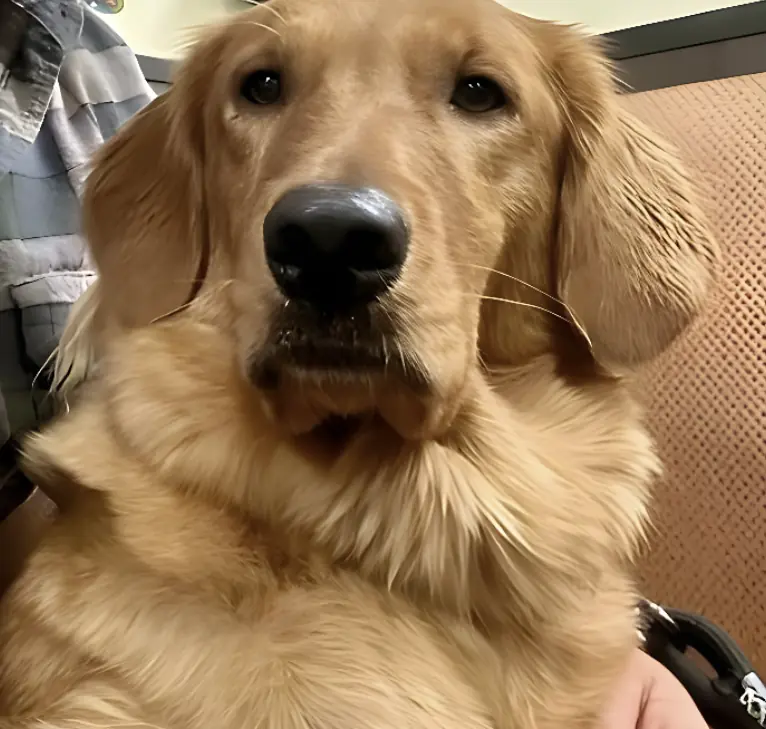
When I first met Bailey, I wasn’t looking for love — or even companionship. I was looking for distraction, something to fill the hollow spaces that grief had carved into my life. My husband, Ethan, had been gone for eight months. Eight months of silence, of sleepless nights in a half-empty bed, of unopened mail and unfinished meals.
I had become a ghost in my own home — moving, breathing, existing, but never living.
It was my sister, Marlene, who dragged me to the animal shelter one rainy afternoon. “You need something alive around you,” she’d said. “Something that reminds you the world hasn’t stopped.”
I remember the smell of the place — damp fur, disinfectant, and faint hope. Rows of cages lined the walls, each holding a pair of eyes watching, waiting. Most barked or wagged their tails as we passed. But at the very end of the row sat one dog — quiet, still, with a look that mirrored my own emptiness.
He was a golden retriever mix, his fur matted and dull, his posture slumped. His tag simply read Bailey — 3 years old.
“He doesn’t interact much,” said the volunteer. “He was abandoned a few months ago. Hard to tell what he’s been through.”
When I crouched beside the cage, Bailey lifted his head and met my gaze. No bark, no whine — just eyes that said, I know loss too.
I signed the adoption papers within the hour.
The first week was chaos. Bailey didn’t eat much. He’d flinch at sudden sounds. He’d sit by the window for hours, staring at nothing. I talked to him more than I talked to any human — not because I expected an answer, but because silence was too heavy otherwise.
“Guess it’s just us now,” I said one evening, sitting on the floor beside him. He leaned in, rested his head on my lap, and sighed. A deep, weary sigh that felt like understanding.
That was the first time I cried in months.
Over time, Bailey began to change — little by little. He followed me from room to room, wagged his tail when I came home, and even nudged my hand whenever I was lost in thought too long.
One morning, I found him standing by the door, leash in his mouth. He looked at me expectantly, eyes bright with something like hope.
“Fine,” I said with a laugh I hadn’t used in forever. “You win.”
We started walking every morning after that. Just small loops around the block at first. But somehow, each step made the world feel less suffocating. The air was sharper, cleaner. The sky seemed wider. Bailey would stop to sniff every tree, every post, every invisible scent that only he understood.
He was teaching me, in his quiet way, to notice life again.
Our walks got longer. We started visiting the park near the river — a place Ethan and I used to go before he got sick. At first, the memories stung. But Bailey, sensing my hesitation, would always nudge my hand with his nose, reminding me that the past could hurt and heal at the same time.
One afternoon, while we sat by the water, a little girl ran up to pet him.
“He’s pretty!” she giggled, her tiny hand buried in his fur. “What’s his name?”
“Bailey,” I said.
“Bailey,” she repeated carefully, smiling. “He looks happy.”
I glanced at him. His eyes sparkled under the sunlight, tail thumping gently against the grass.
“Yeah,” I whispered. “He does.”
That night, I realized something had shifted. For the first time, I didn’t cry before bed.
But healing isn’t a straight path.
One stormy night, thunder cracked across the sky, and Bailey bolted upright, shaking. Before I could comfort him, he darted into the hallway, whining, pacing in circles. I followed and found him staring at the door, his body tense.
He must have remembered — whatever trauma he carried before me.
I knelt beside him, whispering softly, “You’re safe, Bailey. I promise.”
It took nearly an hour before he settled. But when he finally lay down, it was beside my bed, close enough that his paw touched the blanket. I reached down and rested my hand on his back. His breathing steadied.
In that small, fragile moment, I realized we were both learning to trust again — one storm at a time.
Months passed. Bailey became my shadow, my morning alarm, my reason to step outside. He had a way of grounding me — pulling me back from the fog whenever I drifted too deep into memory.
I began painting again, something I hadn’t done since Ethan’s death. Bailey would curl up by my easel, head tilted as if studying my brushstrokes. Sometimes, when I mixed colors, I’d talk to him about Ethan — about the way he laughed, the songs he’d hum while cooking. Bailey never judged, never interrupted. He just listened.
One evening, as I finished a landscape — sunlight over a riverbank — I noticed a golden hair stuck in the paint. I smiled. “Guess it’s our masterpiece now, huh?”
He wagged his tail as if to agree.
Then came the day that changed everything again.
We were walking near the river when Bailey suddenly stopped, ears pricked. Before I could react, he took off down the path, leash slipping from my hand.
“Bailey! Come back!” I shouted, running after him.
He sprinted toward the water, barking furiously. At first, I thought he’d gone mad — until I saw it: a small boy clinging to a branch, half-submerged, the current pulling hard.
Without hesitation, Bailey plunged into the river.
My heart pounded as I ran to the bank. “Hold on!” I yelled, grabbing a long branch to extend toward them. But Bailey reached the boy first, paddling beside him, nudging him toward the shore. I waded in up to my knees, grabbed the child’s arm, and pulled with all my strength.
We collapsed on the grass, both shaking. Bailey circled us, barking, then leaned in to lick the boy’s face. The child coughed, sputtered — alive.
When his parents arrived minutes later, sobbing with relief, I looked at Bailey and whispered, “You saved him.”
He wagged his tail once, modest as ever.
But that night, when I looked at him sleeping on the couch, damp fur still smelling of river water, I realized something deeper — he hadn’t just saved the boy. He had saved me.
A local paper wrote about it — “Hero Dog Rescues Child from River.” People congratulated me, but I knew the truth. Bailey had always been a hero, even before that day. Just not in the way headlines could capture.
After that, something shifted in the town — people smiled at us more, stopped to chat during walks. Bailey had become a quiet legend, and I, somehow, was no longer invisible.
A year later, I held an art exhibition — my first since Ethan’s passing. The final painting was of Bailey by the river, golden fur glowing under the sun. The piece was titled Second Chances.
When the gallery lights dimmed, I leaned down and whispered to him, “We did it.”
He licked my hand and looked up at me with eyes full of something words could never touch — gratitude, trust, love.
Today, as I sit by the same riverbank where everything began, Bailey rests his head on my knee. His muzzle is gray now, his steps slower, but his spirit — that boundless light — burns just as bright.
People often ask if I’ll get another dog when he’s gone. I always smile and say, “You don’t replace family.”
Because Bailey wasn’t just my dog. He was my second chance at life — proof that healing doesn’t always come through people, but through the quiet, loyal heartbeat curled up beside you.
And as the sun sets over the water, I whisper to him, “Thank you for finding me when I didn’t even know I was lost.”
Bailey thumps his tail once, softly.
And for the first time in years, I know that love — real, unconditional love — never dies. It just changes shape, waits patiently, and comes back when you’re finally ready to begin again.