When people see a scar, they usually look away. When it’s on a woman’s face, they look twice — first in shock, then in pity. I got used to that long ago. What I never got used to was the way my own family looked at me after I came home.
I was twenty-eight when the explosion happened. A roadside bomb, they said later. I don’t remember much — just the deafening sound, the sudden heat, and then darkness swallowing everything. When I woke up in a field hospital, the left side of my face was bandaged, my skin raw and tight, my hand trembling when I reached up to touch what wasn’t there anymore.
I served twelve years in the army. Those twelve years took more from me than they gave, but they also built something I didn’t know how to describe — resilience, maybe. Or silence.
When they sent me home, the commander told me, “You’ve done your duty, Captain Hayes.”
Duty. That word had always defined me. Until the day it didn’t.
Home was not what I remembered. My mother had aged overnight, my father moved slower, and my younger sister, Claire, still carried the same quiet resentment she’d had when I enlisted.
“You don’t have to prove anything anymore,” she said when I first walked through the door. “You can rest.”
But resting felt like dying slowly.
They tiptoed around me at first. No one mentioned my face. No one asked what happened. I could see the questions burning behind their polite smiles, but they never said a word.
I started working part-time at a veterans’ rehabilitation center — mostly paperwork, helping new arrivals get settled. I told myself I was helping others, but really, I was hiding. The uniform still hung in my closet, pressed and perfect, but I couldn’t bring myself to wear it again.
Then came the day that changed everything.
It was my father’s birthday. Sixty-five. My mother insisted on a family dinner, “just like old times.” I wanted to refuse, but she looked so hopeful that I couldn’t.
By the time I arrived, the house was already full — cousins, aunts, neighbors. Laughter spilled out of the kitchen, the smell of roast chicken and cinnamon filling the air.
And then the conversations stopped when I walked in.
I caught the looks. The same ones I’d seen from strangers, now written on familiar faces. Claire hugged me awkwardly, whispering, “You look good,” which was the kind of lie families tell out of love.
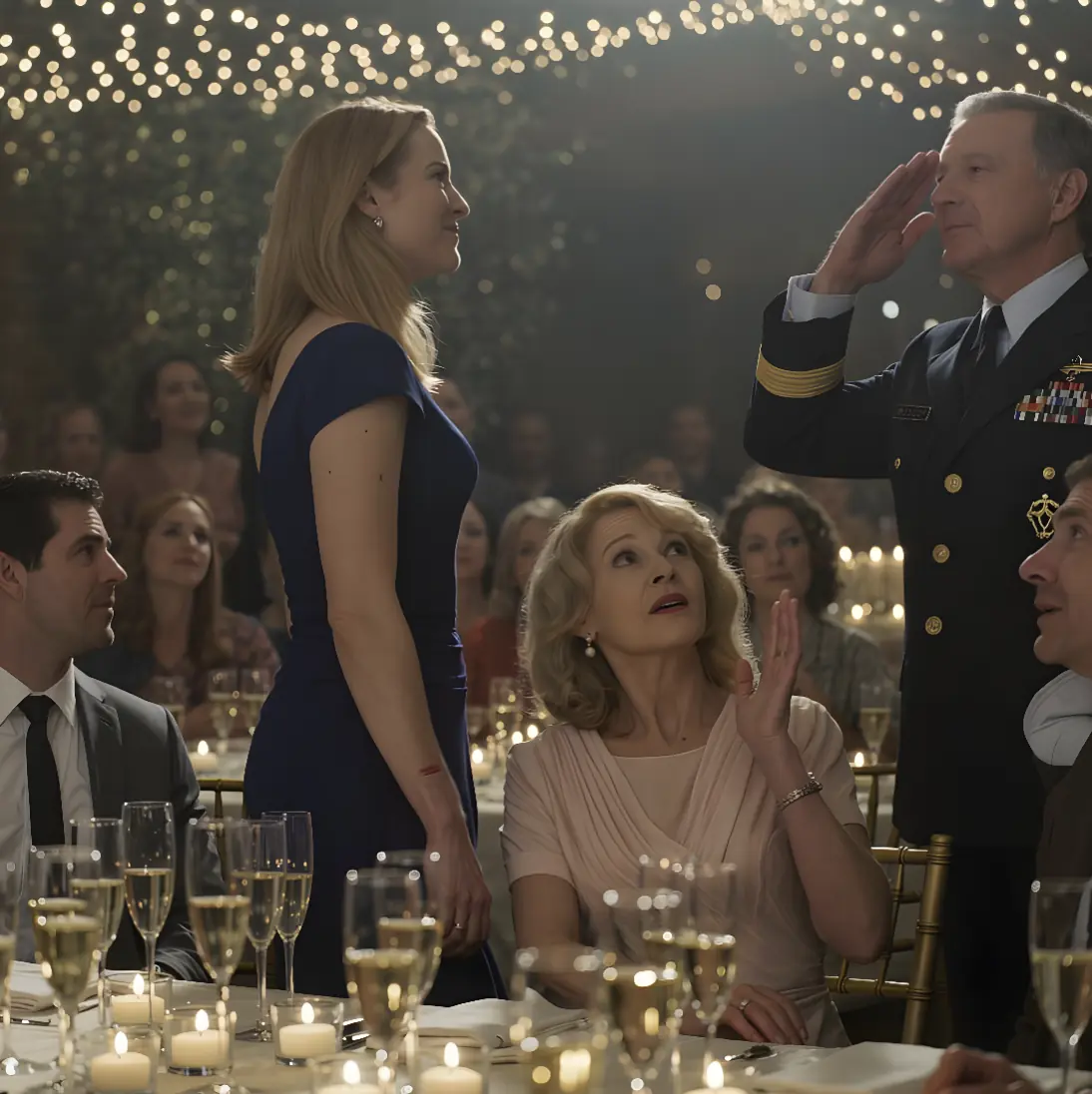
I tried to disappear into a corner, but my father clinked his glass. “Everyone,” he said, “I want to make a toast — to my daughter, Captain Hayes, who came home to us safe.”
Applause filled the room, hesitant but sincere. I smiled stiffly, the scar pulling at my cheek. I didn’t feel safe. I felt exposed.
Later, as dinner went on, the tension eased. My uncle asked about the army; my aunt asked if I’d met anyone special. Normal questions. Then Claire — never one to stay silent — said quietly, “You never talk about it, you know. The explosion. The scar.”
The room went still.
My mother shot her a look. “Claire—”
“No, it’s fine,” I said. I set down my fork. “You want to know what happened?”
Claire hesitated. “I just… I want to understand.”
So I told them.
I told them about the convoy that morning, the call that came through warning of possible IEDs, the brief flash of light before the sound tore the sky apart. I told them how I’d crawled through dirt and smoke to reach a wounded private, how my hands shook as I tied a tourniquet, how the smell of burning metal clung to my skin for weeks after.
I told them how I’d thought I was dead until I realized I could still feel pain.
And then I told them about the moment after the blast — when I saw my reflection for the first time. A half-familiar face, scarred and swollen, staring back with one good eye and one that would never open again.
When I finished, no one spoke.
Then my father, voice shaking, said, “You saved that soldier’s life, didn’t you?”
I nodded. “He was nineteen. His name’s Tyler. He sends me a card every Christmas.”
My mother began to cry softly. Claire stared at me, her eyes wide — not with pity this time, but with something closer to awe.
After dinner, I stepped outside for air. The night was still, the stars sharp and cold above the backyard. I was halfway down the steps when I heard the door open.
It was Claire. She stood there, unsure, holding two mugs of tea. “Mind if I join you?”
I nodded.
We sat in silence for a while before she said, “You know, I was angry at you for years.”
I glanced at her. “I figured.”
“I thought you left because you didn’t want us,” she said. “But now I think you left because you couldn’t stay.”
I stared at the horizon. “Maybe both.”
She hesitated. “Can I ask you something?”
“Sure.”
“When you look in the mirror… what do you see?”
I took a long sip of tea, thinking. “For a long time, I saw what I lost. Now… I try to see what survived.”
Claire looked down, nodding slowly. “I’m sorry for not seeing you sooner.”
That sentence — simple, quiet — hit harder than any medal I’d ever received.
Weeks passed after that dinner. Something shifted in my family. My mother stopped hiding the old photos where I still had both eyes and unbroken skin. My father started introducing me to people as “my daughter, the bravest person I know.”
And Claire — she started showing up at the rehab center where I worked, volunteering on weekends. “You can’t guilt-trip me into therapy,” I joked once. She smirked. “Maybe not. But I can show up anyway.”
One afternoon, she helped organize a fundraiser for veterans. I didn’t want to speak, but she insisted.
“You don’t have to hide behind the uniform anymore,” she said. “Let them see you.”
When I stepped on stage, I didn’t wear medals or badges. Just a simple dress and the scar that no longer felt like a wound. I told the audience about resilience — about how healing doesn’t mean erasing pain but learning to live alongside it.
Afterward, a young woman approached me. “My brother’s in the army,” she said. “He’s been afraid to come home. What should I tell him?”
I smiled. “Tell him home isn’t about who he was before. It’s about who he chooses to be now.”
That night, Claire drove me home. As we passed the quiet streets, she said softly, “I used to think scars were ugly.”
I looked at her. “And now?”
She smiled. “Now I think they’re proof you’ve lived.”
When we reached the house, my father was waiting on the porch with our old dog, Rusty. He wagged his tail when he saw me, old and slow but still loyal.
“Come inside,” my dad called. “Your mom’s making pie.”
I looked at my sister, then at the warm light spilling through the window — the same house I’d once felt I didn’t belong in.
“Yeah,” I said quietly. “I think I will.”
Later, in my room, I took the old uniform from the closet. The medals glinted faintly under the lamp, but it wasn’t the shine that mattered anymore. I traced the seam of the jacket with my fingers — the same way I sometimes touched the edge of my scar.
For years, I thought both were symbols of what had been taken from me. But now, I saw them for what they were: marks of what I had survived.
When I caught my reflection in the mirror, I didn’t flinch this time.
I saw a soldier, yes — but also a sister, a daughter, a woman who had found her way back from the edge and refused to disappear.
And for the first time since the explosion, I smiled. Not to hide the scar — but because I finally understood it.
It wasn’t a reminder of pain.
It was proof of life.