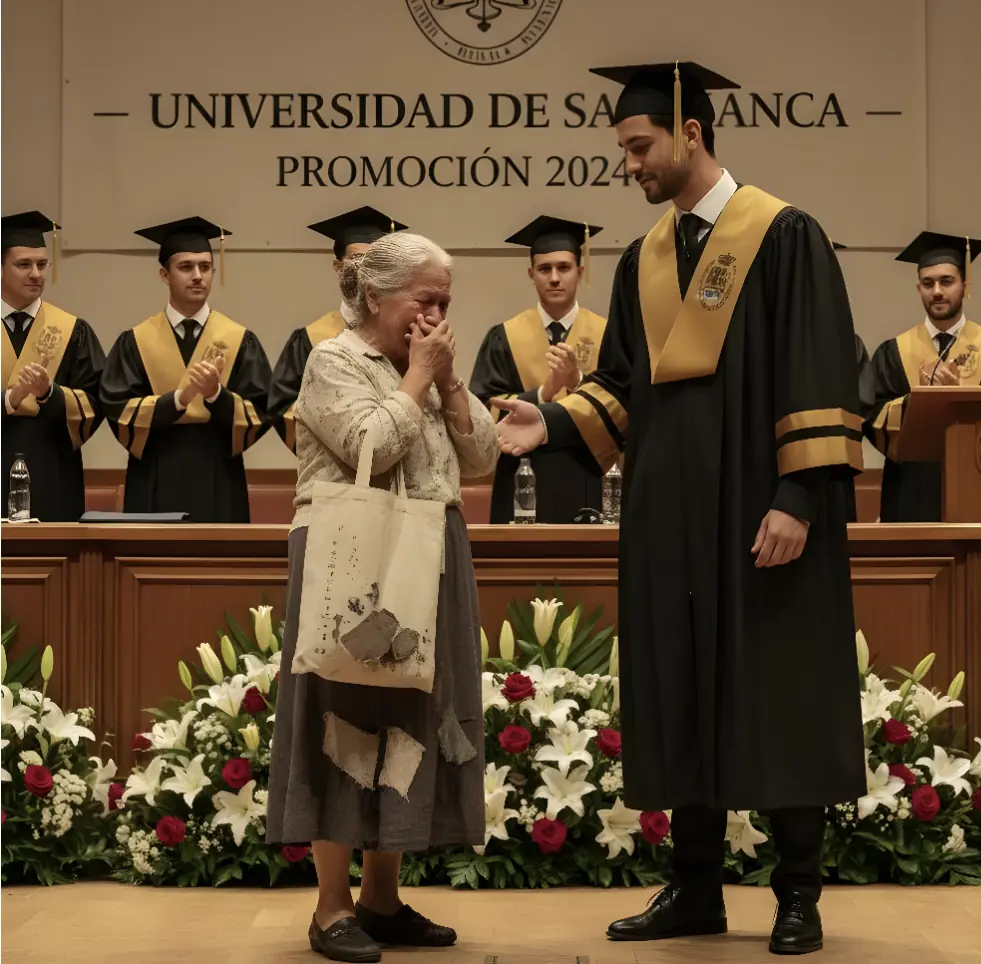
My mother was sixty-eight the day I walked across the stage. Her hands trembled as she pinned the small corsage to her faded dress, and I remember thinking she looked smaller than I remembered — as if the years had slowly folded her into herself.
She had never attended a graduation before. Not mine, not anyone’s. She never finished high school. “Life had other plans,” she always said, with a shrug and a smile that hid too many scars.
I’d spent years trying not to become like her.
Growing up, I was ashamed of everything about my mother — her wrinkled hands, her old shoes, her way of speaking English that still carried the soft lilt of her hometown. She worked as a cleaner in a local hospital for almost forty years.
Every night, she came home smelling of disinfectant and soap, her uniform still damp with sweat. She’d ask, “How was school, Emily?” and I’d mutter something, barely looking up from my books.
She’d smile anyway. “Study hard,” she’d say. “Don’t let my life be the end of our story.”
At the time, I thought it was guilt that drove me — the desire not to disappoint her. But now I realize it was something else entirely: fear. I was terrified that if I slowed down, I’d end up trapped like her — bent, tired, unseen.
When I got into college on a partial scholarship, she cried like I’d announced I’d won the lottery.
“Oh, my little girl,” she said, wiping her eyes. “You’re going to have the life I dreamed of.”
I hugged her stiffly. I was already thinking about the city, about freedom, about escape.
“Don’t worry, Mom,” I said. “I’ll make you proud.”
And I meant it. But I didn’t understand what pride really meant.
College was another world. People wore nice clothes, talked about vacations, internships, stocks. My mother’s voice on the phone became a reminder of everything I wanted to leave behind. When she called, I’d answer with half-hearted replies.
She’d say, “Did you eat?”
“Yes, Mom.”
“You sleeping enough?”
“Yeah, fine.”
And then, “I miss you.”
“Yeah. I miss you too.”
But I didn’t. Not really.
When my roommate once asked what my parents did, I hesitated. “My dad’s gone,” I said truthfully, “and my mom’s… retired.”
She wasn’t. She was cleaning hospital floors so I could have textbooks and decent shoes. But “retired” sounded better. Cleaner.
One winter break, I went home and found her in the kitchen, rubbing her knees, a heating pad tied around one leg.
“You should rest,” I said.
She smiled, tired. “Rest later. Work now.”
When I looked in the fridge, there were leftovers — soup, rice, eggs — but no meat, no milk.
“Mom, what have you been eating?”
She shrugged. “Food’s food.”
I checked her purse when she wasn’t looking. There was barely thirty dollars inside.
I wanted to yell at her. Ask why she wouldn’t let me help. But at that time, I was barely scraping by myself — tutoring freshmen, saving pennies for rent. So instead, I said nothing.
That silence was the heaviest thing I carried back to campus.
The following spring, she collapsed at work. Exhaustion, the doctors said. Low blood pressure. They recommended rest. She told me not to come home, that it was “just a dizzy spell.”
I came anyway.
When I walked into the hospital room, she was sitting up, still in her uniform. The sight of her broke something in me. She looked so small, so fragile — yet still smiling. Always smiling.
“I told you not to come,” she said softly.
“I’m your daughter,” I said. “You really thought I wouldn’t?”
She laughed weakly. “Well, you’ve always been stubborn.”
For the first time in years, I took her hand. It felt rough, cracked, but steady.
That night, as she slept, I looked at her hands and realized those same hands had held me as a baby, packed my lunches, washed my clothes, written checks she couldn’t afford — all without complaint.
And I hated myself for all the years I’d looked away.
When graduation came around the next year, she tried to refuse my invitation.
“Too far,” she said. “Too crowded.”
“Mom,” I insisted, “you have to come. You earned this too.”
She smiled, embarrassed. “Oh, I just mopped some floors, Emily. You did the real work.”
But she agreed, reluctantly, and bought a new pair of shoes — cheap, stiff things that blistered her heels before the ceremony even began.
That morning, I watched her from across the crowd — sitting quietly among families dressed in their best. Her dress was simple, her hat borrowed from a neighbor, but she held her head high.
When my name was called, I walked across the stage to applause that sounded like thunder. But the only sound I heard was her — clapping harder than anyone, tears running down her cheeks.
As I shook the dean’s hand, I thought: This is her victory, not mine.
After the ceremony, I found her waiting near the fountain. Her shoes were off, and she was rubbing her feet.
“You did it,” she said, smiling through tears. “My baby did it.”
I took the diploma from its folder and pressed it into her hands.
“No, Mom,” I said. “You did it.”
She laughed nervously. “Don’t be silly. I can’t read half of that thing.”
“I wouldn’t be here if it wasn’t for you,” I said. “Every step I took — it was on the road you built.”
Her eyes shimmered. “Emily…”
I knelt down, ignoring the stares, and said, “You taught me what strength is. You taught me love doesn’t need to be pretty to be real.”
She started to cry — quiet tears that she tried to hide with her sleeve. I hugged her, right there in front of everyone. For the first time, I didn’t care who saw.
After graduation, I got a job offer from a firm overseas. It was everything I’d dreamed of — salary, prestige, travel. But before I signed, I asked my mother, “If I go, will you come with me?”
She smiled. “No, child. My world is here. Go build yours.”
“But I don’t want to leave you.”
She chuckled. “You won’t. I’ll always be with you. Every time you wake up tired and keep going, every time you help someone who can’t repay you — that’s me.”
I didn’t answer. I just held her hand again, the same hand I’d once been ashamed of.
Three years later, she passed away. Peacefully, they said. In her sleep, at home. I came back for the funeral and found her old trunk under the bed. Inside were all my report cards, my letters, even newspaper clippings from my university — things I didn’t know she’d saved.
On top was a yellowed envelope.
Inside, a short note:
“Dear Emily,
If you’re reading this, I’m probably gone. Don’t cry too long. Just live well. I didn’t have much to give you, but I gave you all I had.
That’s enough for me.”
The handwriting was shaky, the ink faded. But her words burned into my chest.
On the first anniversary of her passing, I went back to my university. There’s a plaque near the fountain — a small one, dedicated to “Those Who Supported Our Journeys.”
I brought flowers and placed them there. Beside them, I left her old hospital badge, the one she’d worn for decades.
A young student passing by asked, “Whose badge is that?”
I smiled. “My mother’s.”
“She was a nurse?”
“No,” I said softly. “She was the reason I’m here.”
That evening, I took a walk along the campus paths. The sun dipped low, the same way it had the day I graduated. I could almost hear her voice again:
“Study hard. Don’t let my life be the end of our story.”
And I realized — it wasn’t.
Her story hadn’t ended; it had simply changed hands.
Now, whenever I see an older woman cleaning hospital floors or sweeping in a school hallway, I stop. I smile. I say, “Thank you.”
Because I’ve learned that greatness doesn’t always wear gowns or hold degrees. Sometimes, it wears tired eyes and carries a mop.
Sometimes, it’s sixty-eight years old, sitting barefoot by a fountain, clapping with pride for the daughter she raised all on her own.
And that — that is the truest honor I will ever know.