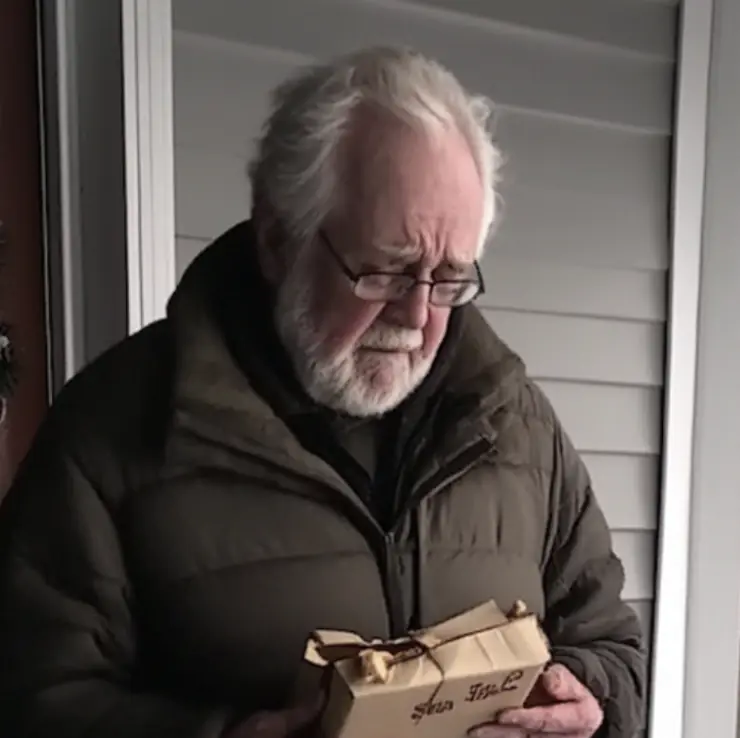
Harold Bennett sat at the small wooden table by the window, the same one his wife, Margaret, had polished every Sunday morning for forty years. A white tablecloth covered it now, pressed and spotless. There was a single candle in the center, flickering faintly against the cold winter light.
He glanced at the clock. 4:47 p.m. They were supposed to arrive at five. His son, Robert. His daughter, Linda. Two grandchildren he barely knew except through Facebook photos that someone else had printed out for him.
He had mailed the invitations himself, handwriting shaky but legible. “Come celebrate with your old man—93 and still standing!” he’d written with forced cheerfulness. He imagined laughter filling the kitchen, his daughter’s perfume mixing with the scent of roast chicken, the grandchildren playing with Rex, his golden retriever, who now slept more than he barked.
But for now, only the ticking of the clock and the faint hum of the refrigerator kept him company.
He’d been preparing all week. The chicken was roasting slowly in the oven, potatoes mashed, carrots glazed. Even Margaret’s old china—carefully wrapped for years—sat waiting on the table, their delicate blue flowers catching the fading light.
As the minutes crept toward five, Harold adjusted his cardigan and smoothed his thin white hair. He glanced at the framed photos along the wall—his wedding day, Robert’s graduation, Linda holding her newborn. He smiled faintly. “They’ll come,” he whispered. “They’ll come.”
At 5:15, he lit the candle. At 5:30, he poured the wine. At 5:45, he turned the chicken down to keep it warm. At six, the sky outside had turned indigo.
Still, no one came.
Rex stirred from his spot by the fireplace, his cloudy eyes blinking as if sensing his master’s quiet disappointment. Harold reached down, patting his head gently. “It’s all right, boy. They’re just running late.”
But as the clock struck seven, he stopped pretending.
He blew out the candle, its thin trail of smoke curling into the air. The wine glass trembled in his hand. “I suppose people have their lives to live,” he said softly, half to Rex, half to himself. “Old men like me—we fade into the background.”
Then came the knock.
It startled him so much that he almost spilled his drink. The knock came again—gentle, hesitant. He shuffled toward the door, cane tapping against the wooden floor. When he opened it, the porch light revealed a young woman standing there, her hair damp from the drizzle. She looked to be in her twenties, clutching a small paper bag.
“Mr. Bennett?” she asked, voice unsure.
“Yes,” he said, blinking in surprise. “Can I help you?”
“I… I’m sorry to bother you. My car broke down a few blocks away, and your house was the only one with the lights on. The others looked empty.”
He hesitated, then smiled faintly. “Well, you’re lucky. Tonight’s my birthday, and I was just about to have dinner. Come in before you freeze.”
Her eyes widened. “Oh, I couldn’t—”
“Nonsense,” he said, waving her in. “I made enough for a small army.”
She stepped inside cautiously, taking in the cozy room—the warm fire, the set table, the faint scent of roasted chicken. “It’s lovely,” she said softly.
“Thank you,” Harold replied, closing the door. “Name’s Harold. And you are…?”
“Emily,” she said. “Emily Foster.”
“Well, Emily Foster,” he said with a chuckle, “you just saved me from eating dinner alone.”
He served her a plate, pouring her a glass of wine despite her protests. “A little won’t hurt,” he said. “It’s my birthday tradition.”
They sat across from each other, the candle burning again between them. Emily ate quietly at first, occasionally glancing at the photos on the wall.
“You have a beautiful family,” she said finally.
“Thank you,” he murmured. “At least I used to.”
Her brow furrowed. “Used to?”
He shrugged. “Life happens. My wife passed ten years ago. My son and daughter… well, they have their own families now. We don’t talk much.”
Emily’s eyes softened. “I’m sorry.”
He smiled faintly. “Don’t be. I had a good life. More than most. I just miss the noise, you know? The laughter.” He gestured toward the empty chairs. “I kept expecting them to come.”
Emily looked down at her plate. “Maybe they still will.”
Harold chuckled. “At my age, you learn not to expect much. But having company tonight—that’s enough.”
They talked for hours. Emily told him she was a nurse in training, working double shifts to pay for school. She lived alone, didn’t have much family. “My mom passed when I was twelve,” she said. “Dad left long before that.”
Harold listened, nodding slowly. “You must be strong.”
“I guess,” she said quietly. “Sometimes I just feel tired.”
He smiled warmly. “You remind me of my wife. She used to say that strength isn’t about never getting tired—it’s about keeping going anyway.”
When they finished eating, he brought out the cake—small, store-bought, with uneven lettering that read Happy Birthday, Harold! He laughed at the sight. “I ordered it myself. That’s how you know you’re old—you start buying your own birthday cake.”
Emily grinned. “Then I’ll make it official.” She struck a match and lit the single candle. “Make a wish.”
He closed his eyes. For a long time, he said nothing. Then he whispered, “I wish I could see my family again. Just once. To tell them I forgive them.”
When he opened his eyes, Emily was smiling softly. “That’s a good wish.”
They shared the cake, and for the first time that night, the silence in the room felt peaceful.
By the time the clock struck ten, Emily stood to leave. “Thank you, Mr. Bennett. For dinner. For… the company.”
He patted her hand gently. “You saved an old man from a lonely birthday. That’s thanks enough.”
She hesitated at the door. “Would you mind if I came back sometime? Maybe to check on you?”
His eyes brightened. “I’d like that very much.”
After she left, Harold sat in his chair, smiling to himself. The candle had burned low, but the warmth lingered. For the first time in years, he didn’t feel invisible.
The next morning, a car pulled into his driveway. Robert and Linda stepped out, carrying gift bags. “Dad’s probably mad we’re late,” Linda muttered. “The traffic was awful.”
But when they entered the house, they found him sitting peacefully in his chair by the fire, eyes closed, a faint smile on his lips. The candle was out.
On the table, beside the empty plates, lay a folded note.
“Don’t be sad. I had a lovely birthday. Thank you for everything, even the memories. Be kind to strangers—you never know when they’ll be angels.”
The police found no trace of the young woman Harold had dined with. No car, no footprints, nothing.
But every year since, on Harold’s birthday, the neighbors say they see a light in the window of the old Bennett house. A single candle, glowing softly. And sometimes—just sometimes—a faint voice laughing with someone unseen.