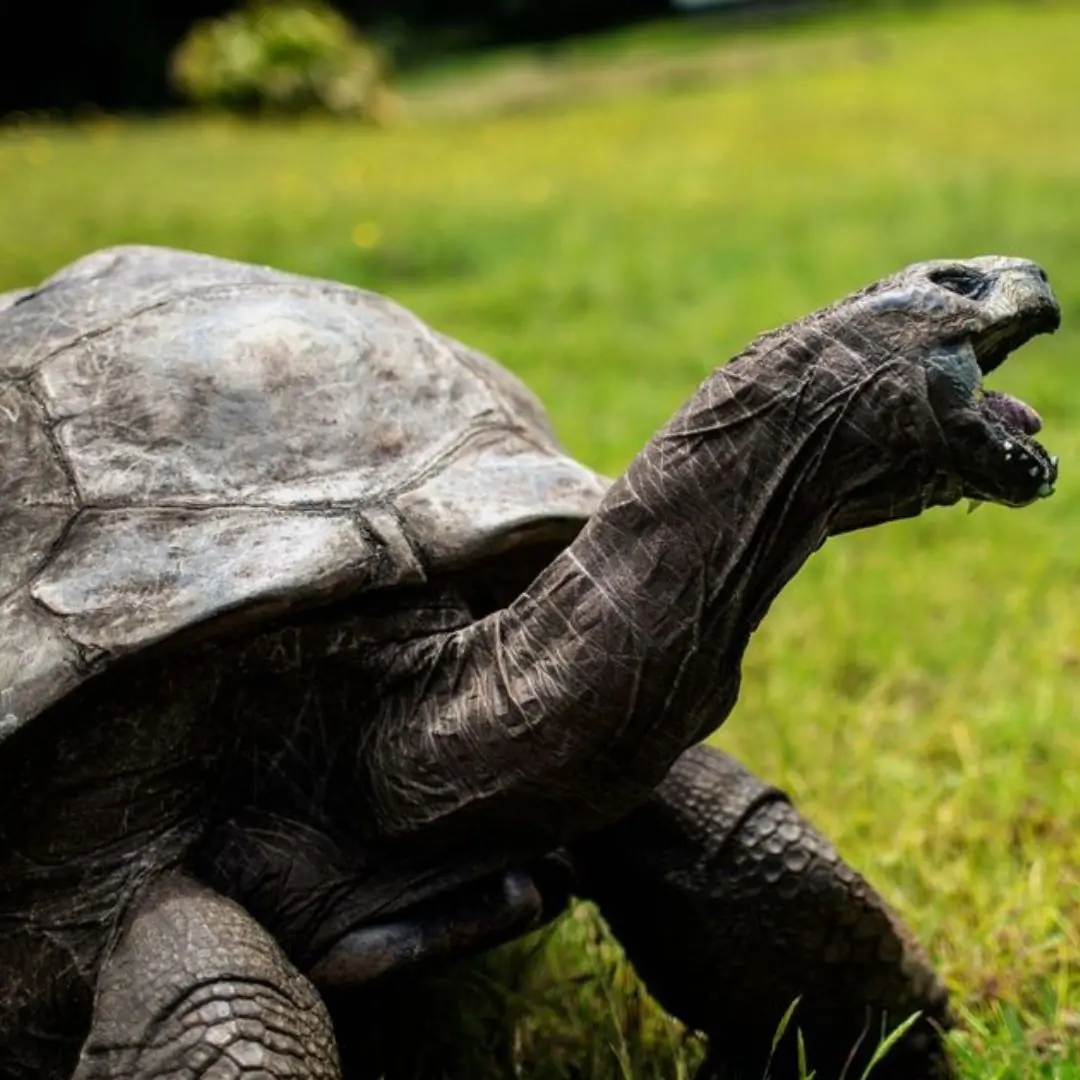
On a small volcanic island in the South Atlantic Ocean called Saint Helena lives a creature so old that he was born long before electricity, cars, or airplanes were invented. His name is Jonathan, and he is recognized as the world’s oldest living land animal.
Jonathan is a Seychelles giant tortoise, and according to historical records, he was born around 1832. To put that into perspective, Jonathan was already forty years old when the light bulb was invented, sixty years old when the first car hit the road, and eighty when the Wright brothers flew their first airplane. Today, at over 190 years old, Jonathan is still alive, making him not just a tortoise, but a living link to history.
Jonathan first arrived on Saint Helena in 1882. He was a gift to the island’s governor, Sir William Grey-Wilson, brought all the way from the Seychelles in the Indian Ocean. At that time, Jonathan was already fifty years old, though people probably didn’t realize it. They simply saw a healthy, strong tortoise with a long life ahead.
From then on, Jonathan made the island his home. He was kept on the grounds of Plantation House, the official residence of the governors of Saint Helena. Over the decades, he quietly roamed the gardens, grazed on grass, and basked in the warm sun. Governors and politicians came and went, wars raged across the world, empires rose and fell—but Jonathan just kept living, slowly, steadily, one day at a time.
The people of Saint Helena grew deeply attached to him. Generations of islanders grew up seeing Jonathan on visits to Plantation House. Children who once ran to feed him grew into parents, then grandparents, bringing their own children to meet the legendary tortoise. He became more than just an animal; he became part of the island’s identity, a symbol of resilience and peace.
As Jonathan aged past 150, his health began to show signs of decline. His eyesight weakened until he became completely blind. His sense of smell faded too. Yet he adapted, relying on his sharp sense of hearing to recognize the footsteps and voices of his caretakers.
The islanders rallied around him. Vets and volunteers made sure Jonathan received the best care possible. Since he could no longer graze easily, caretakers hand-fed him meals of fresh fruits and vegetables, making sure his diet was rich and balanced. He especially enjoyed cucumbers, apples, and carrots. Sometimes he even ate straight from the hands of his keepers, showing trust built over many years.
Jonathan is not just remarkable because of his age, but also because of what his life represents. He was alive during the reign of Queen Victoria, saw the world through two world wars, and continued to thrive while technology transformed human civilization. He outlived nearly all historical figures of his time.
In fact, when Jonathan was born, photography itself was just being invented. Today, he has been photographed countless times, his image traveling instantly across the internet—a world he could never understand, but one that celebrates him nonetheless.
One of the most heartwarming aspects of Jonathan’s story is his companionship with other tortoises on the island. For years, he lived with another tortoise named Frederica, and the two were believed to be a male and female pair. For decades, caretakers thought they were a couple. But in 2017, when Frederica needed surgery, vets discovered “she” was actually a male! The news made people laugh with affection. Jonathan and Frederica—renamed Frederick—remained close friends, a reminder that companionship matters more than labels.
In 2022, Jonathan celebrated his 190th birthday, a milestone never officially reached by any other known land animal. The island of Saint Helena threw a huge celebration in his honor. Local children drew birthday cards, residents baked cakes (for people, not tortoises), and officials honored Jonathan as a national treasure. For three days, festivities lit up the small island, and Jonathan basked quietly in the garden, unaware of the fuss but deeply loved by all.
International media covered the event, calling Jonathan a “global celebrity.” Yet for the people of Saint Helena, he was more than that. He was family.
Jonathan’s story touches so many hearts because it is a reminder of time itself. While humans rush through their days, chasing goals and battling worries, Jonathan has lived by simply existing. He eats, rests, and moves at his own pace. He carries no hurry, no fear of the future. In his slow rhythm, people find wisdom: the value of patience, resilience, and living fully in the present.
Caretakers often say that despite his blindness, Jonathan still seems content. When he hears familiar voices, he stretches his long neck toward them, sometimes resting his head against their hands. For an animal that has seen nearly two centuries of human change, perhaps the simplest things—food, sunshine, companionship—are what truly matter.
Today, Jonathan continues to live peacefully at Plantation House. Tourists from around the world visit Saint Helena just to catch a glimpse of him. They leave with photographs, but also with a sense of awe. Meeting Jonathan feels like touching history itself.
No one knows exactly how many more years Jonathan will live. But whether it is one more year or ten, his legacy is already secure. He has become a symbol of endurance, a quiet reminder that life, even when lived slowly, can be extraordinary.
And so, on a small island far from the noise of modern cities, Jonathan the tortoise continues his journey. His shell bears the marks of time, his steps are slower now, but his presence is timeless. As the world keeps changing around him, Jonathan remains the same: steady, gentle, and enduring—a living bridge between centuries.