The afternoon sun filtered weakly through the blinds of Evelyn Carter’s small apartment, dust motes dancing in the light. The kettle whistled softly on the stove, its sound oddly soothing — until the knock came.
Three sharp raps. Familiar. Controlled.
She froze. Only one person ever knocked like that.
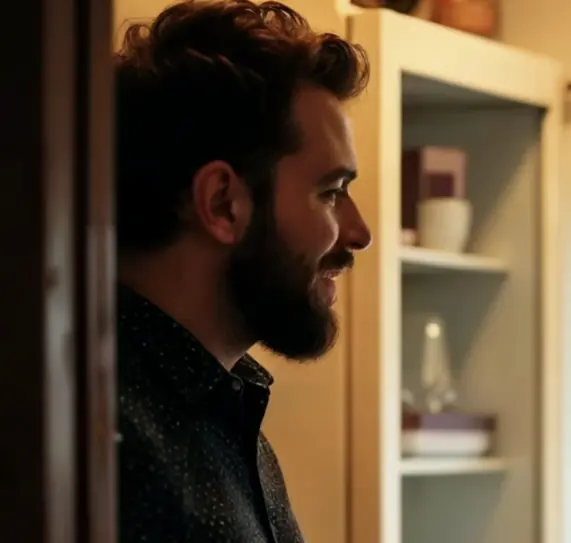
When she opened the door, there he was — Mark Carter, her husband, in his pressed gray suit, his tie still perfect, his expression calm.
He looked at her as if she were an employee who had missed a deadline.
“Evelyn,” he said, voice cool and clipped. “We need to talk.”
She blinked. “We? You kicked me out three months ago.”
His jaw tightened, but his tone didn’t change. “And I’ve had time to think. I’ve decided to give you a second chance.”
For a moment, she thought she’d misheard him. Then she laughed — a soft, incredulous sound.
“You’ve decided?” she repeated. “Like you’re promoting me back to my old position?”
He frowned slightly, as if her sarcasm were unprofessional. “I’m trying to do the right thing here, Evelyn. I miss what we had. The house feels empty.”
“The house?” she said. “Not me?”
He hesitated, caught off guard by the question. “You know what I mean.”
“No,” she said, folding her arms. “I really don’t.”
Three months earlier, it had ended quietly, brutally.
One argument too many. One accusation too far.
“You’re holding me back,” he’d said, his face cold, distant. “You’ve lost your ambition. You don’t understand the kind of life I want.”
And with that, he’d told her to leave.
No shouting. No begging. Just a man who viewed marriage as a project that had run its course.
Evelyn had packed her things that night, numb but composed. She hadn’t even cried — not then. Only later, when she realized she didn’t know where to go, had the tears come.
Now, standing in her tiny apartment, she saw him for what he truly was: a man who mistook control for love.
“Mark,” she said slowly, “why are you really here?”
He exhaled, running a hand through his hair — a gesture he used when trying to look sincere. “Because I made a mistake. We both did. I think we can fix this.”
“Fix what, exactly?”
“Our marriage.”
Evelyn tilted her head. “The same marriage you ended without hesitation?”
He gave a small, dismissive shrug. “You know how I get when I’m angry. I say things I don’t mean.”
She smiled faintly. “You meant every word, Mark. You always mean them.”
He stepped closer. “Look, I’m not perfect. But you and I — we work. You grounded me. You made me better.”
She stared at him for a long moment. “No, Mark. I made you comfortable.”
He looked genuinely puzzled. “Comfortable?”
“You needed someone who would smooth the edges, handle the details, applaud your victories. I did all that. And you rewarded me by calling me a burden.”
His expression hardened. “Are you going to punish me forever for one mistake?”
“I’m not punishing you,” she said softly. “I’m just not returning to being invisible.”
He glanced around the small apartment — the plants on the windowsill, the stack of books by the sofa, the art supplies on the table.
“You’ve been… painting?” he asked, surprised.
Evelyn nodded. “Every day.”
“I didn’t know you still did that.”
“You didn’t ask.”
He shifted, uncomfortable. “You seem… different.”
“I am,” she said simply.
For the first time, his confidence faltered.
He’d come expecting gratitude, maybe even tears. The woman before him was calm, unshaken. It unsettled him.
He took a step back, then forward again, as if recalibrating his strategy.
“Listen,” he said, softer now. “We had good years. I was under pressure then — new contracts, new investors. I wasn’t myself. But I’ve been thinking, and—”
“Mark,” she interrupted. “Do you remember the night before your promotion party?”
He frowned. “Of course.”
“You asked me to cancel dinner with my sister because you needed me to ‘prepare the guest list,’ remember?”
He nodded. “You were always better with names.”
She smiled sadly. “That was the night I found out she’d been diagnosed with lymphoma. I didn’t go to see her because you told me that evening was about your career.”
He froze.
“I spent that night making place cards and ordering wine while she sat alone in a hospital bed. And the next morning, when I told you, you said, ‘You did the right thing. Family understands.’”
Her voice didn’t tremble, but her hands did.
Mark looked away. “I didn’t know it was that serious.”
“You didn’t ask,” she said again.
A long silence followed. The clock ticked softly.
Finally, she said, “I’ve built something small but mine, Mark. I paint, I teach art classes, I have friends who see me — really see me. And I’ve realized something.”
He looked up, wary. “What?”
“I don’t want a second chance at the life you offered. Because that life wasn’t living. It was performing.”
He opened his mouth, then closed it. For the first time, words seemed to fail him.
“Evelyn, I can change,” he said finally. “I’ll prove it.”
“No, you won’t,” she said gently. “You’ll adapt — until things feel safe again. Then you’ll slip back into the man who needs to win every argument.”
“That’s unfair.”
“So was being discarded like a faulty investment.”
He winced.
He turned toward the door, his jaw tight. “You’re making a mistake.”
“Maybe,” she said. “But it’s mine to make.”
He hesitated, then said, almost coldly, “You’ll regret this.”
She smiled faintly. “I used to regret marrying you. Now I don’t regret leaving.”
After he left, Evelyn stood for a long time by the door, listening to the echo of his footsteps fade down the hall. Then she sat down and took a long breath — one that felt like release.
The kettle whistled again, and this time she didn’t silence it immediately.
Instead, she poured herself a cup of tea, sat by the window, and let the rain begin to fall against the glass.
Outside, the city moved on, unaware of the quiet revolution happening in her small apartment — the moment a woman reclaimed her peace.
Weeks passed.
One afternoon, she received a thick envelope in the mail. Inside was a letter — from Mark.
He wrote about how he couldn’t stop thinking about what she’d said, about how he wanted to learn, to “be better.” He asked to meet.
She read it twice, folded it neatly, and set it aside.
Later that evening, she went to her art class. She smiled at her students — middle-aged women, young men, retirees, all learning to find color again after their own gray seasons.
“Today,” she said, picking up a brush, “we’re painting something we’ve outgrown.”
Someone asked, “What if we’re not sure what that is yet?”
Evelyn smiled. “Then start with the outline. The details will come.”
As the sun set, streaking orange across the sky, she stood back to look at her own canvas.
A doorway. A storm outside. And beyond it, light spilling in.
It wasn’t perfect — not yet. But it was honest.
And for Evelyn, that was enough.
Later that night, she opened her balcony door, letting the cool air wash over her.
She thought of Mark — not with anger anymore, but with distance. He was a chapter she’d closed, a lesson she’d survived.
She picked up her phone, typed a short reply to his letter, and hit send:
Thank you for reaching out. I wish you peace — the kind I finally have.
Then she turned off the light, her apartment quiet except for the faint hum of the city below.
For the first time in years, she didn’t feel small.
She didn’t feel lost.
She simply felt free.