Part One
The sun was just beginning to rise over the wide, golden expanse of the savannah. Thin rays of light pierced through the morning mist, painting the land in shades of amber and soft rose. Birds stirred in the acacia trees, and somewhere far in the distance, the faint rumble of elephants could be heard — low, thunder-like calls echoing across the plains.
Leila adjusted the strap of her worn leather satchel and squinted against the light. She had been awake since dawn, notebook in hand, boots covered in red dust. Her job at the wildlife conservancy was never predictable — each day carried its own story, its own heartbeat. She thought she had grown used to surprises, but nothing could have prepared her for the day she found the calf.
It happened while she was driving the old Jeep along a dirt road near the riverbend. At first, she noticed vultures circling low, black specks swirling in the pale sky. She slowed down, her heart quickening. Where vultures gathered, death was never far away.
When she reached the bend, her breath caught.
A female elephant lay collapsed on her side, her massive body still and lifeless. The cruel marks of poachers were evident — deep wounds, tusks already taken. It wasn’t the first time Leila had seen such devastation, but it never grew easier. Rage and sorrow battled inside her chest.
Then she heard it — a thin, pitiful trumpet.
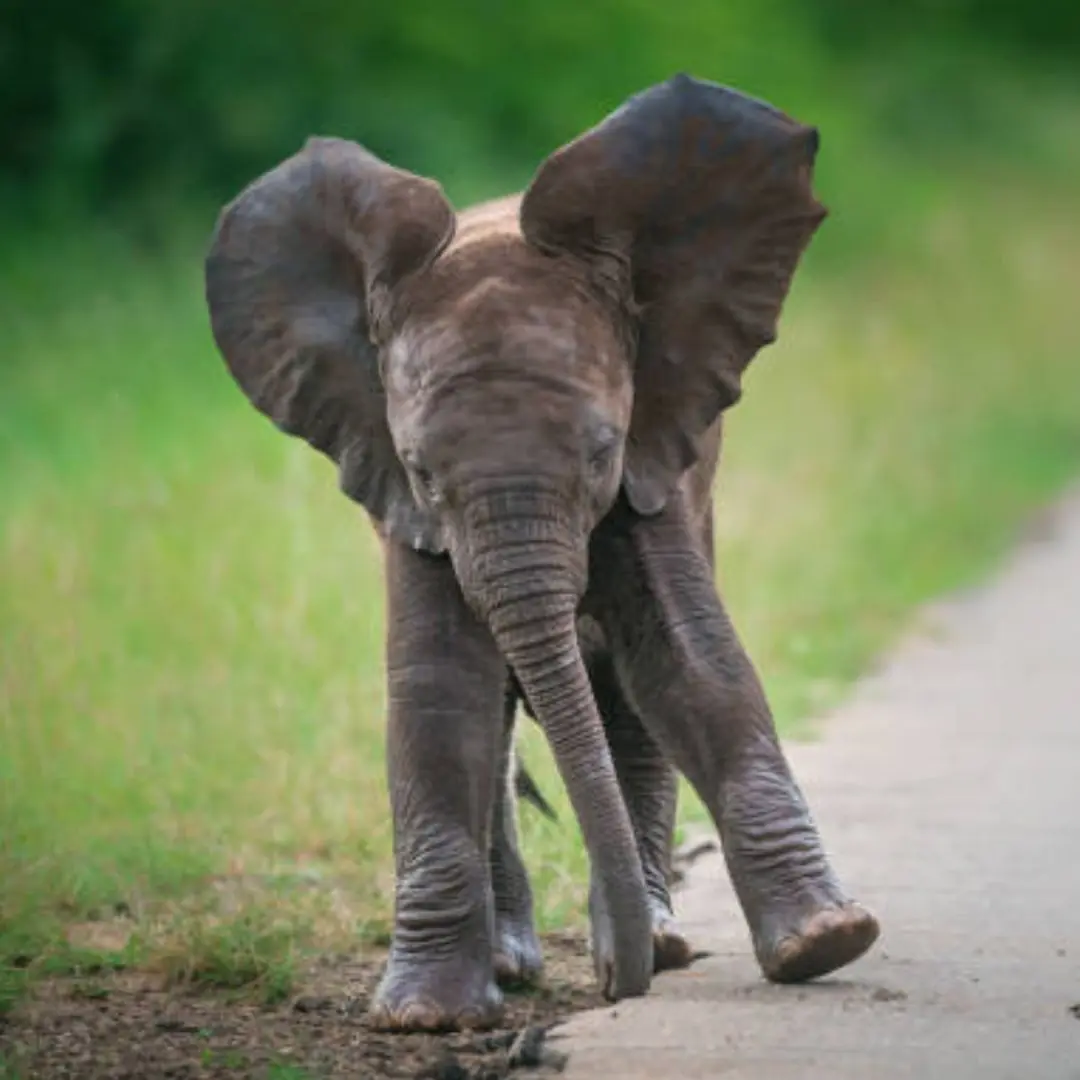
Behind the carcass, a calf stood trembling, his ears flapping wildly, eyes glazed with confusion and terror. He couldn’t have been more than six months old. His tiny trunk reached out to his mother’s unmoving body, prodding her as if begging her to rise. Each push was followed by a high, shrill cry that pierced straight into Leila’s soul.
Her throat tightened. She knew the cruel truth: without intervention, the calf wouldn’t survive long.
Leila climbed out of the Jeep slowly, keeping her movements calm and deliberate. The calf noticed her and stumbled backward, ears spread in panic.
“Easy,” she whispered, though she knew he couldn’t understand her words. Her voice, however, carried warmth, a softness that nature itself seemed to hush for. “I’m not here to hurt you.”
It took hours of patience, of standing nearby without sudden movement, of waiting for the calf’s sobs to quiet into wary silence. Eventually, exhaustion overcame fear. The little elephant collapsed onto his knees beside his mother, his body shaking with each breath.
Leila radioed the conservancy team.
By nightfall, the calf had been transported to the rehabilitation center — a sanctuary of sorts, though surrounded not by fences, but by carefully designed open land, guarded day and night. There, orphans like him had a chance to live.
The days that followed were difficult. The calf, whom Leila named Kito (meaning “precious” in Swahili), refused food at first. He cried for his mother, pacing the small enclosure where he had been placed, banging his head against the wooden posts, his grief palpable.
Leila spent hours sitting near him, just outside the enclosure, humming softly while writing notes she barely remembered later. Sometimes she read aloud from her journal — passages of her own thoughts, the kind she never shared with anyone else.
“I think,” she wrote one evening, “that loss is a language every living thing understands. His cries are the same as mine when I lost my father. The same as the silence I carry every day. Maybe if I stay, he won’t have to carry his grief alone.”
Eventually, Kito began to accept milk from a giant bottle. His trunk, still clumsy and uncertain, would wrap around it with hesitation, but hunger always won.
The first time he nudged her gently with his forehead, as though testing her presence, Leila felt tears sting her eyes. It wasn’t trust yet — but it was a beginning.
Weeks turned into months.
Kito grew stronger, his legs sturdier, his eyes brighter. He began to follow Leila around like a shadow, his steps heavy but endearing. The other orphaned calves at the center slowly accepted him, and for the first time, Leila witnessed him play — splashing clumsily in a mud bath, his joyful trumpets ringing across the sanctuary.
But his attachment to Leila was different. When storms rolled in and thunder cracked the skies, it was her voice he sought, her scent that calmed him. At night, if he woke frightened, he wouldn’t sleep until he saw her nearby.
“You’re going to break my heart one day,” she whispered to him one night, stroking his rough, warm forehead as he drifted back to sleep. “But that’s alright. Some hearts are meant to be broken.”
Two years passed.
Kito was no longer the fragile calf she had rescued. He was tall now, his tusks just beginning to emerge, his strength undeniable. The team at the conservancy began to discuss his eventual release back into the wild.
Leila knew it was coming. From the beginning, that had always been the goal: to give them back their freedom. Still, the thought of letting him go sliced her deeply. He wasn’t just an elephant to her anymore. He was family.
Her journal filled with reflections she never spoke aloud:
-
Is love still love if it’s temporary?
-
Do animals grieve when they leave us, or is it only humans who cling so tightly?
-
Maybe true love is not holding on, but letting go.
One morning, as Leila was observing Kito near the watering hole, a wild herd of elephants appeared on the horizon. They approached cautiously, their matriarch leading with slow, deliberate steps.
Kito froze, his ears lifted, his trunk raised to catch their scent. For the first time, he looked at Leila, then back at the herd, as if torn between two worlds.
Her heart pounded.
This was the moment she had both dreaded and prayed for.
“Go on,” she whispered, though her voice cracked. “That’s where you belong.”
Kito took a hesitant step forward, then another. The wild elephants rumbled softly, welcoming him into their circle. He paused once more, glancing back at Leila. Their eyes met across the distance — his dark, ancient gaze holding something she could never quite name. Gratitude? Love? Farewell?
And then he turned, walking into the herd, disappearing into the vastness of the savannah.
Leila stood frozen, the wind tangling her hair, her eyes burning with unshed tears.
She had saved him. But in truth, he had saved her too.
(Part II)
The sun had already begun its slow descent, painting the skies of the savannah with soft streaks of orange and purple. Jabari walked beside Kito, his tiny feet sinking into the golden dust. The elephant moved slowly, each step heavy but graceful, as though he carried the weight of all the seasons of the savannah in his great body.
For a while, neither of them spoke. Jabari didn’t have to say much; Kito’s presence was enough. The boy’s heart pounded with the thrill of discovery. He had found a friend that none of his peers could ever imagine.
“Do you… miss your family?” Jabari finally whispered, tilting his head up at the massive creature.
Kito’s ears flapped slowly, and his deep eyes, dark pools reflecting the setting sun, turned to the boy. A low rumble vibrated in his chest—an elephant’s answer. It wasn’t a word, but Jabari felt the meaning settle into his bones: Yes. Every day.
The boy lowered his gaze. He thought of his own father, who had left for the city months ago in search of work and hadn’t returned. His mother worked tirelessly at home, tending goats and planting beans, while Jabari often wandered alone after his chores.
“I know what that feels like,” he said softly, his voice cracking. “Missing someone who’s not here.”
Kito reached out his trunk, brushing the boy’s shoulder with surprising gentleness. In that moment, they both understood—they were no longer just lonely souls. They had found each other.
A Secret Bond
Over the next few weeks, Jabari returned to the watering hole every afternoon after tending the cattle. Kito was always there, waiting. Sometimes, they would sit in silence—Jabari weaving little necklaces from grass, Kito splashing water lazily with his trunk. Other times, Jabari would tell Kito stories about his village, about how the elders said elephants never forgot.
“Is it true?” he would ask, and Kito would rumble again, eyes twinkling like old stars.
One afternoon, Jabari arrived with a small mango he had stolen from the neighbor’s tree. “Here,” he said, holding it up proudly. “For you.”
Kito sniffed it curiously, then swallowed it whole in one gulp. Jabari burst out laughing, clutching his stomach. “You didn’t even chew!”
That day, their laughter echoed across the plains, blending with the calls of birds and the whisper of the tall grass. It was the sound of friendship, pure and unbreakable.
Trouble on the Horizon
But peace in the savannah never lasted long.
Hunters had begun roaming the outer edges of the reserve again. Jabari overheard the elders whispering about them one night, voices low and heavy with fear. They came with rifles, searching for ivory.
That word alone made Jabari’s heart squeeze painfully. Ivory meant elephants. Elephants meant Kito.
The next day, when he reached the watering hole, he ran to Kito, throwing his arms against the elephant’s leg. “You must be careful,” he pleaded. “There are bad men coming. They want… they want your tusks.”
Kito stood silently, his great head lowering. He understood. He had seen men like that before. His scars told the story—marks across his ears and legs from traps long ago.
For the first time, Jabari saw fear flicker in Kito’s eyes. It was brief, but it was there.
The Night of Fire
It happened three nights later. Jabari was lying in bed, the distant cries of hyenas in the air, when he heard gunshots echoing across the plains. His heart froze.
He didn’t think. He just ran. Barefoot, through the thorny scrub, across the moonlit grasses, his breath ragged and tears streaming down his cheeks. He knew where the sound came from.
The watering hole.
When he reached it, he saw chaos. Men with flashlights moved through the reeds, their rifles gleaming. And there—towering in the center—was Kito, trumpeting in rage and fear, his massive body outlined by firelight.
“NO!” Jabari screamed, his small voice piercing the night.
The hunters turned, startled. “What’s that kid doing here?!” one shouted.
But before they could act, Jabari ran straight to Kito, standing in front of him with arms wide open. His body trembled, but his eyes burned with courage.
“You can’t hurt him!” he cried. “He’s my friend!”
For a moment, time froze. The hunters hesitated. Their flashlights wavered. And in that heartbeat, Kito charged. With thunderous strength, he knocked down one of the hunters’ trucks, sending men scrambling into the darkness.
Dust and smoke filled the air. Jabari clung to Kito’s leg, heart pounding. Together, they had survived the night of fire.