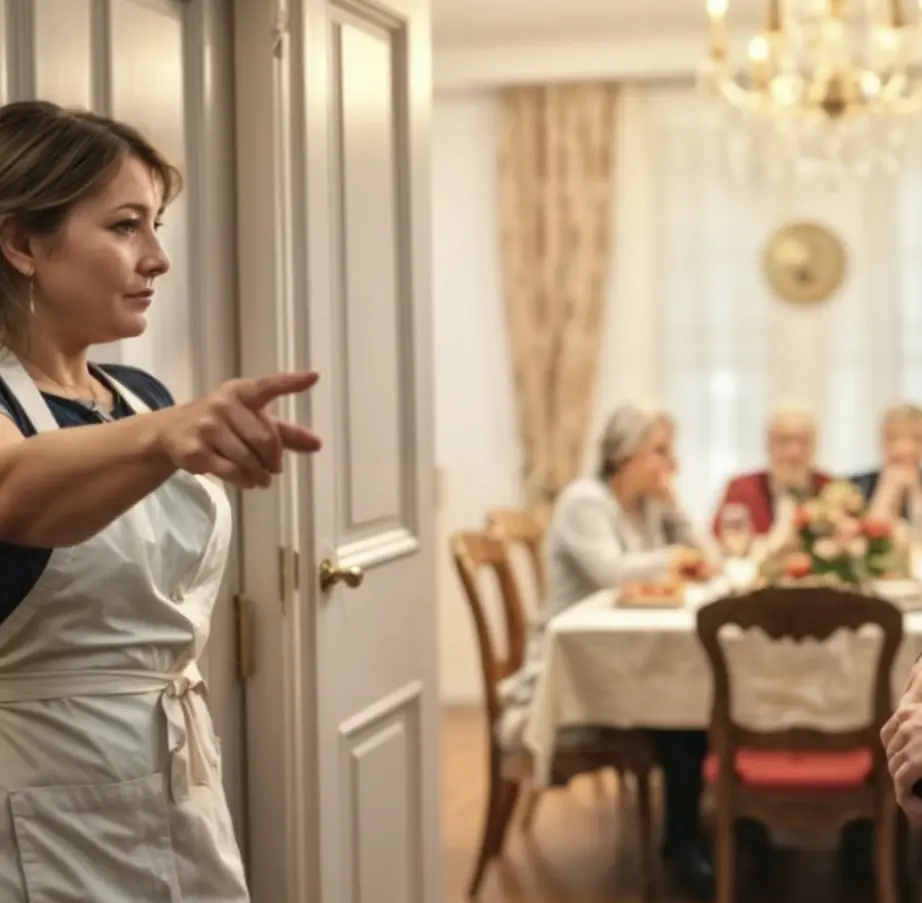
The smell of roasted chicken filled the small kitchen, mingling with the faint sound of rain tapping on the window. Clara wiped her hands on her apron and checked the oven again—everything looked perfect. She’d followed her mother-in-law’s exact recipe, right down to the herbs. She’d even plated it on the fancy porcelain dishes Margaret had gifted them at the wedding, the ones she “didn’t think Clara would know how to use properly.”
And yet, as the older woman sat at the head of the table, fork in hand, Clara could feel it coming. That sigh. That tiny frown.
Margaret tasted a small bite, paused, and shook her head. “Too dry,” she announced. “When I cooked for my late husband, the meat was always tender. You’ve probably kept it in the oven too long.”
Clara forced a smile, though her jaw ached from holding it. Across the table, her husband, Mark, stared down at his plate like a coward.
“Thank you for the feedback, Margaret,” Clara said, her tone polite, almost brittle. “I’ll keep that in mind.”
Margaret leaned back, folding her arms. “If you want my advice—”
“I don’t,” Clara cut in before she could stop herself.
The room went silent.
Margaret’s eyebrows arched. “Excuse me?”
“I said,” Clara repeated, standing now, “I don’t need your advice. I’ve cooked, cleaned, and hosted for weeks while you’ve found something wrong with every single thing I do.”
Mark’s eyes widened. “Clara—”
“No, Mark,” she said, voice rising, years of restraint slipping free. “Your mother has commented on my cooking, my clothes, even how I fold the towels. I’ve tried being polite, but I’m done.”
Margaret’s voice sharpened. “You dare speak to me like this, in my son’s home?”
Clara’s hands trembled, but her voice came steady. “Our home. I pay the bills just like he does.”
The older woman’s face flushed with indignation. “When I was your age, I respected my elders.”
“And when you were my age,” Clara shot back, “no one was expected to tolerate being insulted under their own roof.”
Mark stood up then, his voice soft but firm. “Enough. Both of you.”
Clara turned to him, her heart pounding. “No. Not enough. You’ve let her walk over me since she moved in. I’m not her servant, Mark.”
Margaret gasped, hand clutching her pearls. “Servant? How dare you—”
Clara snapped. “Don’t like my cooking? Leave my house. This isn’t a restaurant.”
For a moment, everything stopped. Rain hammered against the window, the oven timer beeped softly, and three lives stood suspended in a silence that couldn’t be undone.
Then Margaret rose, trembling with outrage. “You’ll regret this insolence,” she hissed.
“Maybe,” Clara replied quietly. “But at least I’ll regret it in peace.”
She left the table, walked into the kitchen, and turned off the oven.
The next morning, the guest room was empty. Margaret’s luggage was gone, her perfume lingered faintly in the hallway, and the house felt strangely hollow.
Mark sat at the kitchen table, staring into his coffee. “You could’ve handled that better.”
“So could you,” Clara said evenly, pouring herself a cup.
He sighed. “She’s my mother, Clara.”
“And I’m your wife.”
The words hung between them.
He rubbed his temples. “You know how she is. She’s old-fashioned. She means well.”
“She means control,” Clara replied. “And you let her.”
Mark didn’t respond. He just stared into his mug like it held all the answers he refused to find.
When he left for work, Clara sat in the quiet house, unsure whether to feel guilty or liberated. Both emotions warred inside her, sharp and heavy. But when she opened the window and felt the fresh morning air rush in, she realized something else: for the first time in months, she could breathe.
Days passed. Margaret didn’t call. Mark grew distant, nursing his hurt pride and divided loyalties. But life went on. Clara returned to her freelance work, met friends for coffee, and started cooking meals for herself—food that didn’t have to impress anyone.
One evening, she made a simple pasta dish and sat down alone. The house was peaceful. She even hummed as she ate.
Then the phone rang.
She hesitated before answering. “Hello?”
A shaky voice came through the line. “Clara, it’s… Margaret.”
Clara straightened. “Is everything all right?”
There was a pause. “No,” Margaret admitted quietly. “Your father-in-law’s watch—the one Mark gave me—was stolen. I went to report it, and I—” Her voice broke. “I fainted at the police station. The doctor says it’s stress.”
Clara exhaled slowly. “I’m sorry to hear that.”
“I shouldn’t have spoken to you that way,” Margaret said suddenly. “You’re a good wife. I see that now. I just… I didn’t know how to let go. Mark was always my world, and when you came along, I thought I’d lost him.”
Clara swallowed. “You didn’t lose him, Margaret. You just gained someone else who loves him.”
There was a long silence. Then, softly, “Would you mind if I came by tomorrow? Just to talk.”
Clara hesitated. Every instinct screamed caution. But something in Margaret’s voice—fragile, human—disarmed her.
“Of course,” she said finally. “I’ll make tea.”
When Margaret arrived the next day, she looked smaller somehow. Her usual air of superiority had been replaced by humility—and fear. She sat at the table, eyes darting to the floor.
“I didn’t realize how lonely I’d become,” she said. “After my husband passed, I thought if I stayed close to Mark, I could fill the silence. But all I did was bring it here.”
Clara poured tea, her heart softening. “We all deal with grief differently.”
Margaret smiled faintly. “You remind me of myself when I was your age. I suppose that’s why we clash.”
Clara almost laughed. “That, and the chicken.”
Margaret chuckled—a small, honest sound. “It really was a bit dry.”
They both laughed then, quietly but genuinely. For the first time, the house didn’t feel divided.
When Mark returned that evening, he found them sitting together, tea cups empty, an apple pie cooling on the counter.
“What’s this?” he asked, stunned.
“Peace,” Clara said simply.
Months later, things weren’t perfect—but they were better. Margaret moved into a nearby apartment, close enough to visit but far enough to keep her boundaries. She still offered advice, but now she asked before doing so.
And every Sunday, Clara cooked dinner. Sometimes it was perfect, sometimes not. Margaret still made her little comments, but they came with a smile.
One night, as they cleared the table, Margaret touched her arm gently. “You were right that night, you know,” she said softly. “This isn’t a restaurant. It’s your home. You’ve made it warm again.”
Clara smiled. “It’s ours now—if we both want it to be.”
Margaret nodded, eyes glistening. “I do.”
Mark walked in just then, chuckling. “You two finally on the same team?”
Margaret smirked. “Oh, we’ve always been. We just needed a strong referee.”
As laughter filled the kitchen, Clara realized something simple but profound: sometimes it takes standing your ground to make room for understanding.
And though that night had started with the words “Don’t like my cooking? Leave my house,”—it had, in its strange way, been the moment that truly made this house a home.