The old house on Sycamore Lane had stood unchanged for decades — white paint faded, porch light still flickering, the oak tree out front stubbornly leaning toward the sun. To strangers, it was just another small-town relic. But to Clara, it was the one place she’d sworn never to return to.
And yet, there she was, suitcase in hand, staring at the door she’d once slammed so many times as a teenager.
The drive had been long, filled with too much silence and the weight of ten years’ worth of words left unsaid.
She wasn’t sure what terrified her more — facing her father again, or realizing that maybe, after all this time, he wouldn’t want to face her.
The last time they’d spoken properly was the night she left for New York. The argument had been small at first — about college loans, about safety, about her “chasing a fantasy.” But then anger took over, sharp and ugly.
“You’re just like your mother,” he had said. “Always running from what’s real.”
She’d thrown back, “And you’re too scared to live!”
It was the kind of line that sounds cinematic when you’re twenty and selfish, but not when you’re thirty and full of regret.
She hadn’t seen him since.
Until last week, when the phone call came.
“This is St. Mary’s Hospital. We have a patient listed as William Hart. Are you his daughter?”
She didn’t answer right away. Her throat closed around the word yes.
“He’s stable,” the nurse said gently. “But you might want to come soon.”
Now she stood on the porch, the evening sun painting everything gold. She could hear a faint radio playing inside — old country music, his favorite.
When the door opened, it wasn’t him.
“Clara?” A woman in scrubs blinked at her. “I’m Marie. The home nurse.”
“Is he—”
“He’s in the living room. Been waiting for you since morning.”
The nurse smiled kindly, then stepped aside.
Clara’s pulse quickened as she walked in.
The house smelled the same: pine cleaner, coffee, and the faint scent of machine oil from the garage. She turned the corner — and there he was.
Her father.
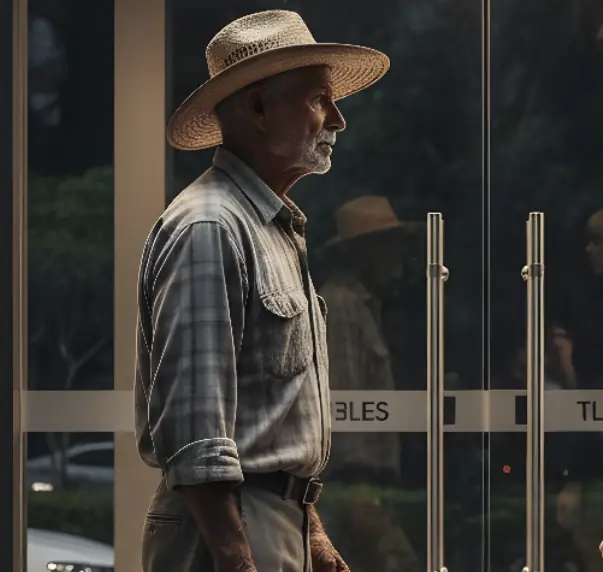
Older, thinner. His hands trembled as he set down his mug. But his eyes — still the same steel blue that could pierce through any lie.
“Hi, Dad,” she said softly.
He didn’t speak right away. Just looked at her, studying her face like he was afraid it might vanish. Then his lips curved upward.
“You cut your hair.”
That was it. Two words, and the years between them began to crumble.
They talked in fragments at first. Weather. The town. Her job — which she described vaguely, omitting the layoffs, the loneliness, the almost-marriage that never happened.
He listened, nodding slowly, as if memorizing each syllable.
When she finally asked about his health, he shrugged. “Heart gave me a warning tap, that’s all. Doctors said it’s fixable. Guess I just got tired of pretending I’m invincible.”
There was silence then. Heavy, but not hostile.
“I should’ve called sooner,” she said.
“Yeah,” he replied. “But you came. That’s what matters.”
He said it so simply, it almost broke her.
The days that followed blurred together. She helped him walk, cooked his meals, fixed the porch light that had been flickering for years. They fell into an unspoken rhythm, cautious but familiar.
Sometimes she’d catch him watching her with that same quiet awe — as if every moment together was a small miracle he didn’t dare take for granted.
And then one morning, she found him in the workshop — the one he’d built behind the garage, where he used to fix radios and clocks.
He was sanding something.
“What are you doing out here?” she asked, trying to sound stern.
He grinned, sawdust on his sleeves. “Working on a surprise.”
“For who?”
“For you,” he said. “Didn’t think I’d get another chance.”
It turned out to be a wooden jewelry box. Simple. Unvarnished. Inside the lid, carved with trembling hands, were five words:
“Home is still your name.”
She traced the letters, her eyes burning. “Dad, I don’t deserve—”
“Stop.” He put a finger on her wrist. “You think leaving cancels love? You think time deletes it?”
He coughed lightly, catching his breath. “You’ve always been stubborn. You ran because you had to see the world for yourself. I hated it then. But I get it now.”
“Why didn’t you ever tell me that?”
“Because,” he said, smiling faintly, “I was too busy waiting for you to come home.”
That night, the storm rolled in — the kind of thunder that rattles old houses and pulls secrets out of their corners. They sat together by candlelight when the power went out.
He asked her to read aloud from her old college essay, one he’d found tucked in a drawer.
She laughed through tears. “You kept this?”
“Everything,” he said. “Every postcard, every photo, every scrap that said you existed somewhere out there.”
She read, her voice unsteady but warm:
“Home is the place that teaches you how to leave, and loves you enough to wait until you come back.”
When she finished, neither of them spoke. The candle flickered. The storm softened into rain.
In the morning, she found him asleep in his chair, breathing softly. The box still sat on the table beside him, her name glowing faintly in the light.
He lived another three months. Long enough for them to rebuild what had once broken, word by word, meal by meal.
When the end came, it was peaceful. The nurse said he smiled before he went.
At the funeral, the small-town church was packed — neighbors, coworkers, people she hadn’t seen since childhood. But what struck her most was how many of them came up to say, “He never stopped talking about you.”
After the service, she drove back to Sycamore Lane. The house felt different now — not empty, but steady, as if it had exhaled after holding its breath for years.
She sat on the porch steps, the jewelry box on her lap.
Inside, she’d added one more carving beneath his words:
“And love never leaves.”
Weeks later, she packed up his things, donated what she could, and set off again — not running this time, but carrying something with her.
In her car, the radio played one of his old songs. She rolled down the window, letting the wind pull through her hair.
For the first time in a long time, she felt light.
She wasn’t driving away anymore. She was driving forward.
Because home, she finally understood, wasn’t a house.
It was the steady heartbeat of someone who’d loved her even when she couldn’t love herself.
And though that heartbeat was gone, its echo would guide her — steady, unwavering — wherever she went next.